Overview
Illustration showing person with acromegaly

Illustration showing person with acromegaly
Symptoms of acromegaly include an enlarged face and hands. Changes to the face may cause the brow bone and lower jawbone to protrude, and the nose and lips to get larger.
Acromegaly is a hormonal disorder that develops when your pituitary gland produces too much growth hormone during adulthood.
When you have too much growth hormone, your bones increase in size. In childhood, this leads to increased height and is called gigantism. But in adulthood, a change in height doesn't occur. Instead, the increase in bone size is limited to the bones of your hands, feet and face, and is called acromegaly.
Because acromegaly is uncommon and the physical changes occur slowly over many years, the condition sometimes takes a long time to recognize. Untreated, high levels of growth hormone can affect other parts of the body, in addition to your bones. This can lead to serious — sometimes even life-threatening — health problems. But treatment can reduce your risk of complications and significantly improve your symptoms, including the enlargement of your features.
Products & Services
Symptoms
A common sign of acromegaly is enlarged hands and feet. For example, you may notice that you aren't able to put on rings that used to fit, and that your shoe size has progressively increased.
Acromegaly may also cause gradual changes in your face's shape, such as a protruding lower jaw and brow bone, an enlarged nose, thickened lips, and wider spacing between your teeth.
Because acromegaly tends to progress slowly, early signs may not be obvious for years. Sometimes, people notice the physical changes only by comparing old photos with newer ones.
Overall, acromegaly signs and symptoms tend to vary from one person to another, and may include any of the following:
- Enlarged hands and feet.
- Enlarged facial features, including the facial bones, lips, nose and tongue.
- Coarse, oily, thickened skin.
- Excessive sweating and body odor.
- Small outgrowths of skin tissue (skin tags).
- Fatigue and joint or muscle weakness.
- Pain and limited joint mobility.
- A deepened, husky voice due to enlarged vocal cords and sinuses.
- Severe snoring due to obstruction of the upper airway.
- Vision problems.
- Headaches, which may be persistent or severe.
- Menstrual cycle irregularities in women.
- Erectile dysfunction in men.
- Loss of interest in sex.
When to see a doctor
If you have signs and symptoms associated with acromegaly, contact your doctor for an exam.
Acromegaly usually develops slowly. Even your family members may not notice the gradual physical changes that occur with this disorder at first. But early diagnosis is important so that you can start getting proper care. Acromegaly can lead to serious health problems if it's not treated.
Causes
Pituitary gland and hypothalamus
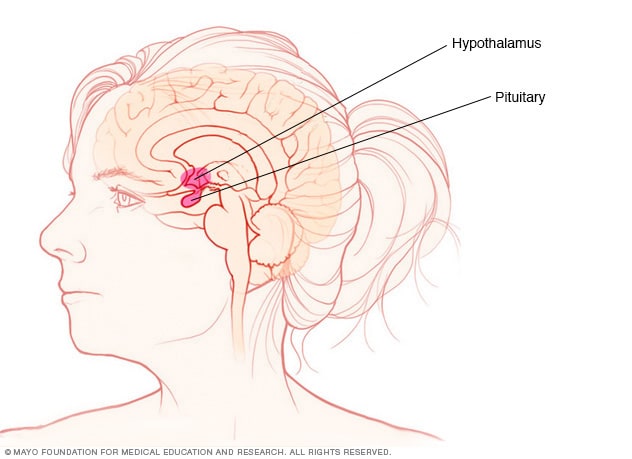
Pituitary gland and hypothalamus
The pituitary gland and the hypothalamus are in the brain. They control hormone production.
Acromegaly occurs when the pituitary gland produces too much growth hormone (GH) over a long period of time.
The pituitary gland is a small gland at the base of your brain, behind the bridge of your nose. It produces GH and a number of other hormones. GH plays an important role in managing your physical growth.
When the pituitary gland releases GH into your bloodstream, it triggers your liver to produce a hormone called insulin-like growth factor-1 (IGF-1) — sometimes also called insulin-like growth factor-I, or IGF-I. IGF-1 is what causes your bones and other tissues to grow. Too much GH leads to too much IGF-1, which can cause acromegaly signs, symptoms and complications.
In adults, a tumor is the most common cause of too much GH production:
- Pituitary tumors. Most acromegaly cases are caused by a noncancerous (benign) tumor (adenoma) of the pituitary gland. The tumor produces excessive amounts of growth hormone, causing many of the signs and symptoms of acromegaly. Some of the symptoms of acromegaly, such as headaches and impaired vision, are due to the tumor pressing on nearby brain tissues.
- Nonpituitary tumors. In a few people with acromegaly, tumors in other parts of the body, such as the lungs or pancreas, cause the disorder. Sometimes, these tumors secrete GH. In other cases, the tumors produce a hormone called growth hormone-releasing hormone (GH-RH), which signals the pituitary gland to make more GH.
Risk factors
People who have a rare genetic condition called multiple endocrine neoplasia, type 1 (MEN 1), have a higher risk of developing acromegaly. In MEN 1, the endocrine glands — usually the parathyroid glands, pancreas and pituitary gland — grow tumors and release extra hormones. Those hormones may trigger acromegaly.
Complications
If left untreated, acromegaly can lead to major health problems. Complications may include:
- High blood pressure (hypertension).
- High cholesterol.
- Heart problems, particularly enlargement of the heart (cardiomyopathy).
- Osteoarthritis.
- Type 2 diabetes.
- Enlargement of the thyroid gland (goiter).
- Precancerous growths (polyps) on the lining of your colon.
- Sleep apnea, a condition in which breathing repeatedly stops and starts during sleep.
- Carpal tunnel syndrome.
- Increased risk of cancerous tumors.
- Spinal cord compression or fractures.
- Vision changes or vision loss.
Early treatment of acromegaly can prevent these complications from developing or becoming worse. Untreated, acromegaly and its complications can lead to premature death.
Feb. 06, 2024