Overview
During allergy skin tests, the skin is exposed to suspected allergy-causing substances, called allergens, and then checked for signs of an allergic reaction.
Along with a medical history, allergy tests may be able to confirm whether a particular substance a person touches, breathes or eats is causing symptoms.
Products & Services
Why it's done
Information from allergy tests may help a healthcare professional develop an allergy treatment plan that includes allergen avoidance, medicines or allergy shots, called immunotherapy.
Allergy skin tests are widely used to help diagnose allergic conditions, including:
- Hay fever, also called allergic rhinitis.
- Allergic asthma.
- Dermatitis, called eczema.
- Food allergies.
- Penicillin allergy.
- Bee venom allergy.
Skin tests are generally safe for adults and children of all ages, including infants. In certain circumstances, though, skin tests aren't recommended. A healthcare professional may advise against skin testing if you:
- Have ever had a severe allergic reaction. You may be so sensitive to certain substances that even the tiny amounts used in skin tests could trigger a life-threatening reaction, known as anaphylaxis.
- Take medicines that could interfere with test results. These include antihistamines, many antidepressants and some heartburn medicines. Your care professional may determine that it's better for you to continue taking these medicines than to temporarily discontinue them in preparation for a skin test.
- Have certain skin conditions. If severe eczema or psoriasis affects large areas of skin on your arms and back — the usual testing sites — there may not be enough clear, uninvolved skin to do an effective test. Other skin conditions, such as dermatographism, can cause unreliable test results.
Blood tests known as in vitro immunoglobulin E antibody tests can be useful for those who shouldn't or can't undergo skin tests. Blood tests aren't used for penicillin allergy.
In general, allergy skin tests are reliable for diagnosing allergies to airborne substances, such as pollen, pet dander and dust mites. Skin testing may help diagnose food allergies. But because food allergies can be complex, you may need additional tests or procedures.
More Information
Risks
The most common side effect of skin testing is slightly swollen, red, itchy bumps, called wheals. These wheals may be most noticeable during the test. In some people, though, an area of swelling, redness and itching may develop a few hours after the test and remain for a couple of days.
Rarely, allergy skin tests can produce a severe, immediate allergic reaction. For this reason, it's important to have skin tests performed at an office where appropriate emergency equipment and medicines are available.
How you prepare
Before recommending a skin test, you will be asked detailed questions about your medical history, your symptoms and your usual way of treating them. Your answers can help determine if allergies run in your family and if an allergic reaction is most likely causing your symptoms. Your healthcare professional also may do a physical examination to search for more clues about the cause of your symptoms.
Medicines can interfere with results
Before scheduling a skin test, bring your healthcare professional a list of all of your prescription and nonprescription medicines. Some medicines can suppress allergic reactions, preventing the skin testing from giving accurate results. Other medicines may increase your risk of developing a severe allergic reaction during a test.
Because medicines clear out of your system at different rates, you may be asked to stop taking certain medicines for up to 10 days. Medicines that can affect the results of skin tests include:
- Prescription antihistamines, such as hydroxyzine (Vistaril).
- Nonprescription antihistamines, such as loratadine (Claritin, Alavert), diphenhydramine, chlorpheniramine, cetirizine (Zyrtec Allergy) and fexofenadine.
- Tricyclic antidepressants, such as nortriptyline (Pamelor) and desipramine (Norpramin).
- Certain heartburn medicines, such as cimetidine and ranitidine.
- The asthma medicine omalizumab (Xolair). This medicine can disrupt test results for six months or longer even after you quit using it. For comparison, most medicines affect results for days to weeks.
What you can expect
Skin testing is usually done at a medical professional's office. Typically, this test takes about 20 to 40 minutes. Some tests find immediate allergic reactions, which develop within minutes of exposure to an allergen. Other tests find delayed allergic reactions, which develop over a period of several days.
Skin prick test
Positive reaction to allergy test
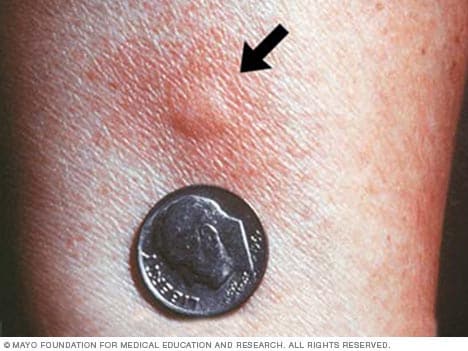
Positive reaction to allergy test
A small area of swelling with surrounding redness is typical of a positive allergy skin test.
A skin prick test, also called a puncture or scratch test, checks for immediate allergic reactions to as many as 50 different substances at once. This test is usually done to identify allergies to pollen, mold, pet dander, dust mites and foods. In adults, the test is usually done on the forearm. Children may be tested on the upper back.
Allergy skin tests aren't painful. This type of testing uses needles, called lancets, that barely penetrate the skin's surface. You won't bleed or feel more than mild, momentary discomfort.
After cleaning the test site with alcohol small marks are drawn on your skin and a drop of allergen extract is applied next to each mark. A lancet is then used to prick the extracts into the skin's surface. A new lancet is used for each allergen.
To see if your skin is reacting typically, two additional substances are scratched into your skin's surface:
- Histamine. In most people, this substance causes a skin response. If you don't react to histamine, your allergy skin test may not reveal an allergy even if you have one.
- Glycerin or saline. In most people, these substances don't cause any reaction. If you do react to glycerin or saline, you may have sensitive skin. Test results will need to be interpreted carefully to avoid a false allergy diagnosis.
About 15 minutes after the skin pricks, your skin is watched for signs of allergic reactions. If you are allergic to one of the substances tested, you'll develop a raised, red, itchy bump, called a wheal, that may look like a mosquito bite. The size of the bump is measured and results are recorded. Next, the marks on your skin will be removed with alcohol.
Skin injection test
You may need a test that uses a needle to inject a small amount of allergen extract just into the skin on your arm. This is called an intradermal test. The injection site is examined after about 15 minutes for signs of an allergic reaction. This test may be recommended to check for an allergy to insect venom or penicillin.
Patch test
Patch testing is generally done to see whether a particular substance is causing allergic skin inflammation, called contact dermatitis. Patch tests can detect delayed allergic reactions, which can take several days to develop.
Patch tests don't use needles. Instead, allergens are applied to patches, which are then placed on your skin. During a patch test, your skin may be exposed to 20 to 30 extracts of substances that can cause contact dermatitis. These can include latex, medicines, fragrances, preservatives, hair dyes, metals and resins.
You wear the patches on your arm or back for 48 hours. During this time, you should avoid bathing and activities that cause heavy sweating. The patches are removed when you return to the allergy specialist's office. Irritated skin at the patch site may mean an allergy.
Results
Before you leave the medical office, you'll know the results of a skin prick test or an intradermal test. A patch test may take several days or more to get results.
A positive skin test means that you may be allergic to a particular substance. Bigger wheals usually mean a greater degree of sensitivity. A negative skin test means that you probably aren't allergic to a particular allergen.
Keep in mind, skin tests aren't always accurate. They sometimes show an allergy when there isn't one. This is called a false-positive. In some cases, skin testing may not trigger a reaction when you're exposed to something that you are allergic to, called a false-negative. You may react differently to the same test performed on different occasions. Or you may react positively to a substance during a test but not react to it in everyday life.
Your allergy treatment plan may include medicines, immunotherapy, changes to your work or home environment, or dietary changes. Ask your allergy specialist to explain anything about your diagnosis or treatment that you don't understand. With test results that identify your allergens and a treatment plan to help you take control, you'll be able to reduce or get rid of allergy symptoms.