Overview
Ankle-brachial index
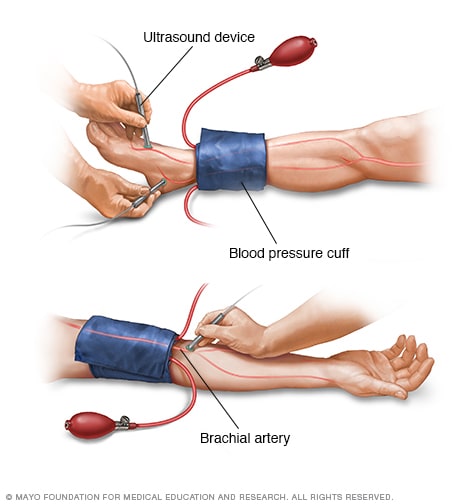
Ankle-brachial index
To determine the ankle-brachial index, a care provider measures the blood pressure in an ankle and an arm. The ankle-brachial index can help check for peripheral artery disease (PAD).
The ankle-brachial index test is a quick, simple way to check for peripheral artery disease (PAD). The disease occurs when narrowed arteries reduce the blood flow to the arms and legs. PAD can cause leg pain when walking. PAD also increases the risk of heart attack and stroke.
The ankle-brachial index test compares the blood pressure measured at the ankle with the blood pressure measured at the arm. A low ankle-brachial index number can indicate narrowing or blockage of the arteries in the legs.
Ankle-brachial index testing might be done before and right after walking on a treadmill. This is called an exercise ankle-brachial index test. It can find out how badly the arteries are narrowed walking.
Products & Services
Why it's done
The ankle-brachial index test is done to check for PAD — narrowed arteries that reduce blood flow, usually in the legs.
An ankle-brachial index test might be useful for people who have leg pain while walking. The test also can be useful for people who have risk factors for PAD.
Risk factors for PAD include:
- History of tobacco use
- Diabetes
- High blood pressure
- High cholesterol
- Restricted blood flow (atherosclerosis) in other parts of the body
Risks
The blood pressure cuffs might cause pain on the arm and leg while they inflate. But this discomfort is temporary and should stop when the air is released from the cuff.
Severe leg pain might require a different imaging test of the arteries in the legs.
How you prepare
No special preparations are needed for an ankle-brachial index test. The test is painless and similar to having blood pressure taken in a routine medical visit. Wear loose, comfortable clothing. This allows the provider doing the ankle-brachial index test to easily place a blood pressure cuff on an ankle and upper arm.
What you can expect
During the procedure
You likely will be asked to rest for 5 to 30 minutes before the test.
Typically, you lie on a table on your back. A care provider measures your blood pressure in both arms and both ankles. This is done using an inflatable cuff and a hand-held ultrasound device that's pressed on the skin. The device uses sound waves to produce images and allows the pulse in the ankle arteries to be heard after the cuff is deflated.
After the procedure
The ankle-brachial index test should take only a few minutes. No special precautions are needed afterward. Your health care provider will discuss your test result with you.
Results
The blood pressure measurements from the arms and ankles are used to determine the ankle-brachial index. The index is a ratio of the two measurements.
Based on the number calculated, your ankle-brachial index may show you have:
- No blockage (1.0 to 1.4). An ankle-brachial index number in this range suggests that you probably don't have PAD. But if you have symptoms of PAD, you might have an exercise ankle-brachial index test.
- Borderline blockage (0.90 to 0.99). An ankle-brachial index number in this range indicates borderline PAD. You might have an exercise ankle-brachial index test.
- PAD (less than 0.90). An ankle-brachial index number in this range indicates a diagnosis of PAD. You might have more testing, such as ultrasound or angiography, to view the arteries in your legs.
People with hard-to-control or long-standing diabetes or significantly blocked arteries might need to have a blood pressure reading at the big toe (toe-brachial index) to get an accurate test result.
Depending on the severity of the blockage, treatment might involve:
- Lifestyle changes
- Medication
- Surgery to treat PAD
Aug. 20, 2022