Overview
Bell's palsy is a condition that causes sudden weakness in the muscles on one side of the face. Often the weakness is short-term and improves over weeks. The weakness makes half of the face appear to droop. Smiles are one-sided, and the eye on the affected side is hard to close.
Bell's palsy also is known as acute peripheral facial palsy of unknown cause. It can occur at any age. The exact cause is not known. Experts think it's caused by swelling and irritation of the nerve that controls the muscles on one side of the face. Bell's palsy could be caused by a reaction that occurs after a viral infection.
Symptoms usually start to improve within a few weeks, with complete recovery in about six months. A small number of people continue to have some Bell's palsy symptoms for life. Rarely, Bell's palsy occurs more than once.
Products & Services
Symptoms
Facial paralysis
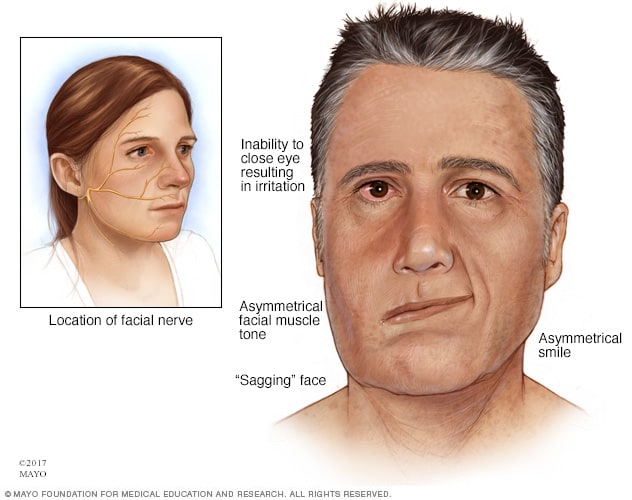
Facial paralysis
The nerve that controls facial muscles passes through a narrow corridor of bone on its way to the face. Facial weakness or paralysis may cause one corner of the mouth to droop, and the mouth may not be able to retain saliva on the paralyzed side of the face. The condition also may make it difficult to close the eye on the affected side of the face.
Symptoms of Bell's palsy come on suddenly and may include:
- Mild weakness to total paralysis on one side of the face — occurring within hours to days.
- Facial droop and trouble making facial expressions, such as closing an eye or smiling.
- Drooling.
- Pain around the jaw or pain in or behind the ear on the affected side.
- Increased sensitivity to sound on the affected side.
- Headache.
- Loss of taste.
- Changes in the amount of tears and saliva produced.
Rarely, Bell's palsy can affect the nerves on both sides of the face.
When to see a doctor
Seek medical help right away if you experience any type of paralysis because you may be having a stroke. Bell's palsy is not caused by a stroke, but the symptoms of both conditions are similar.
If you have facial weakness or drooping, see your healthcare professional to find out the cause and the severity of the illness.
Causes
Although the exact reason Bell's palsy occurs isn't clear, it's often related to having a viral infection. Viruses that have been linked to Bell's palsy include viruses that cause:
- Cold sores and genital herpes, also known as herpes simplex.
- Chickenpox and shingles, also known as herpes zoster.
- Infectious mononucleosis, caused by the Epstein-Barr virus.
- Cytomegalovirus infections.
- Respiratory illnesses, caused by adenoviruses.
- German measles, also known as rubella.
- Mumps, caused by the mumps virus.
- Flu, also known as influenza B.
- Hand-foot-and-mouth disease, caused by a coxsackievirus.
The nerve that controls facial muscles passes through a narrow corridor of bone on its way to the face. In Bell's palsy, that nerve becomes inflamed and swollen — usually related to a viral infection. Besides affecting facial muscles, the nerve affects tears, saliva, taste and a small bone in the middle of the ear.
Risk factors
Bell's palsy occurs more often in people who:
- Are pregnant, especially during the third trimester, or who are in the first week after giving birth.
- Have an upper respiratory infection, such as the flu or a cold.
- Have diabetes.
- Have high blood pressure.
- Have obesity.
It's rare for Bell's palsy to come back. But when it does, there's often a family history of repeated attacks. This suggests that Bell's palsy might have something to do with genes.
Complications
Mild symptoms of Bell's palsy typically disappear within a month. Recovery from more-complete facial paralysis can vary. Complications may include:
- Irreversible damage to your facial nerve.
- Irregular regrowth of nerve fibers. This may result in involuntary contraction of certain muscles when you're trying to move other muscles, known as synkinesis. For example, when you smile, the eye on the affected side may close.
- Partial or complete blindness of the eye that won't close. This is caused by excessive dryness and scratching of the clear protective covering of the eye, known as the cornea.