Overview
A bone density test determines if you have osteoporosis — a disorder characterized by bones that are more fragile and more likely to break.
The test uses X-rays to measure how many grams of calcium and other bone minerals are packed into a segment of bone. The bones that are most commonly tested are in the spine, hip and sometimes the forearm.
Products & Services
Why it's done
Bone density
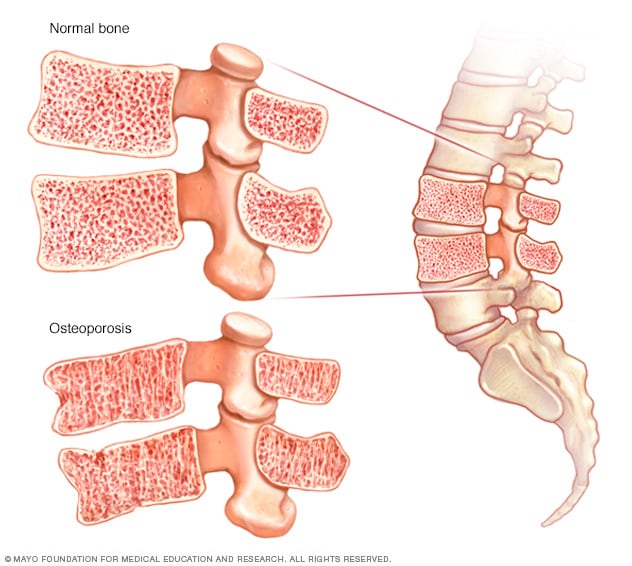
Bone density
With bone loss, the outer shell of a bone becomes thinner and the interior becomes more porous. Normal bone is strong and flexible. Osteoporotic bone is weaker and subject to fracture.
Doctors use bone density testing to:
- Identify decreases in bone density before you break a bone
- Determine your risk of broken bones (fractures)
- Confirm a diagnosis of osteoporosis
- Monitor osteoporosis treatment
The higher your bone mineral content, the denser your bones are. And the denser your bones, the stronger they generally are and the less likely they are to break.
Bone density tests differ from bone scans. Bone scans require an injection beforehand and are usually used to detect fractures, cancer, infections and other abnormalities in the bone.
Although osteoporosis is more common in older women, men also can develop the condition. Regardless of your sex or age, your doctor may recommend a bone density test if you've:
- Lost height. People who have lost at least 1.5 inches (3.8 centimeters) in height may have compression fractures in their spines, for which osteoporosis is one of the main causes.
- Fractured a bone. Fragility fractures occur when a bone becomes so fragile that it breaks much more easily than expected. Fragility fractures can sometimes be caused by a strong cough or sneeze.
- Taken certain drugs. Long-term use of steroid medications, such as prednisone, interferes with the bone-rebuilding process — which can lead to osteoporosis.
- Had a drop in hormone levels. In addition to the natural drop in hormones that occurs after menopause, women's estrogen may also drop during certain cancer treatments. Some treatments for prostate cancer reduce testosterone levels in men. Lowered sex hormone levels weaken bone.
More Information
Risks
Limitations of bone density testing include:
- Differences in testing methods. Devices that measure density of the bones in the spine and hip are more accurate but cost more than do devices that measure density of the peripheral bones of the forearm, finger or heel.
- Previous spinal problems. Test results may not be accurate in people who have structural abnormalities in their spines, such as severe arthritis, previous spinal surgeries or scoliosis.
- Radiation exposure. Bone density testing uses X-rays, but the amount of radiation exposure is usually very small. Even so, pregnant women should avoid these tests.
- Lack of information about the cause. A bone density test can confirm that you have low bone density, but it can't tell you why. To answer that question, you need a more complete medical evaluation.
- Limited insurance coverage. Not all health insurance plans pay for bone density tests, so ask your insurance provider beforehand if this test is covered.
How you prepare
Bone density tests are easy, fast and painless. Virtually no preparation is needed.
Be sure to tell your doctor beforehand if you've recently had a barium exam or had contrast material injected for a CT scan or nuclear medicine test. Contrast materials might interfere with your bone density test.
Food and medications
Avoid taking calcium supplements for at least 24 hours before your bone density test.
Clothing and personal items
Wear loose, comfortable clothing and avoid wearing clothes with zippers, belts or buttons. Leave your jewelry at home and remove all metal objects from your pockets, such as keys, money clips or change. At some facilities, you may be asked to change into an examination gown.
What you can expect
Locations for bone density testing
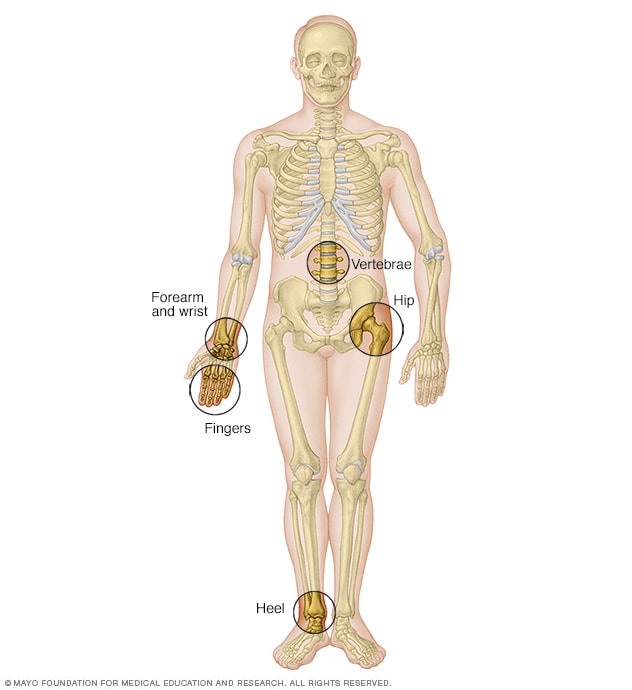
Locations for bone density testing
Bone density tests are usually done on bones in the spine (vertebrae), hip, forearm, wrist, fingers and heel.
Bone density tests are usually done on bones that are most likely to break because of osteoporosis, including:
- Lower spine bones (lumbar vertebrae)
- The narrow neck of your thighbone (femur), next to your hip joint
- Bones in your forearm
If you have your bone density test done at a hospital, it'll probably be done on a device where you lie on a padded platform while a mechanical arm passes over your body. The amount of radiation you're exposed to is very low, much less than the amount emitted during a chest X-ray. The test usually takes about 10 to 30 minutes.
A small, portable machine can measure bone density in the bones at the far ends of your skeleton, such as those in your finger, wrist or heel. The instruments used for these tests are called peripheral devices and are often used at health fairs.
Because bone density can vary from one location in your body to another, a measurement taken at your heel usually isn't as accurate a predictor of fracture risk as a measurement taken at your spine or hip. Consequently, if your test on a peripheral device is positive, your doctor might recommend a follow-up scan at your spine or hip to confirm your diagnosis.
Results
Your bone density test results are reported in two numbers: T-score and Z-score.
T-score
Your T-score is your bone density compared with what is normally expected in a healthy young adult of your sex. Your T-score is the number of units — called standard deviations — that your bone density is above or below the average.
| T-score |
What your score means |
| -1 and above |
Your bone density is considered normal.
|
| Between -1 and -2.5 |
Your score is a sign of osteopenia, a condition in which bone density is below normal and may lead to osteoporosis.
|
| -2.5 and below |
Your bone density indicates you likely have osteoporosis.
|
Z-score
Your Z-score is the number of standard deviations above or below what's normally expected for someone of your age, sex, weight, and ethnic or racial origin. If your Z-score is significantly higher or lower than the average, you may need additional tests to determine the cause of the problem.
Sept. 21, 2022