Overview
AVM blood flow
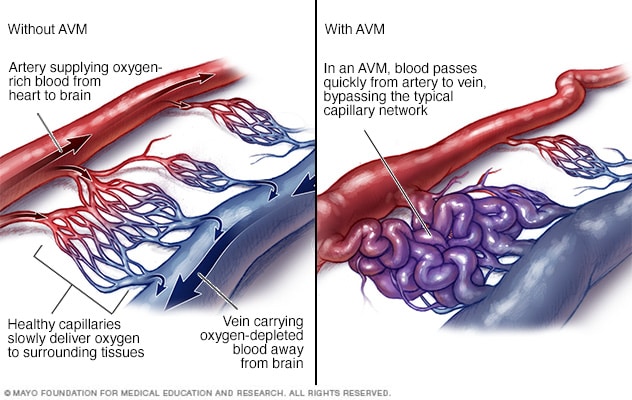
AVM blood flow
In an arteriovenous malformation (AVM), blood passes quickly from the arteries to the veins, disrupting the typical blood flow and depriving the surrounding tissues of oxygen.
An arteriovenous malformation (AVM) is a tangle of blood vessels that irregularly connects arteries and veins, disrupting blood flow and oxygen circulation. Arteries move oxygen-rich blood from the heart to the brain and other organs. Veins drain the oxygen-depleted blood back to the lungs and heart.
When an AVM disrupts this critical process, the surrounding tissues might not get enough oxygen. Also, because the tangled blood vessels in an AVM do not form properly, they can weaken and rupture. If an AVM in the brain ruptures, it can cause bleeding in the brain, stroke or brain damage. Bleeding in the brain also is called hemorrhage.
Read more about brain AVM (arteriovenous malformation).
The cause of AVMs is not clear. They're rarely hereditary, meaning passed down in families.
Once diagnosed, a brain AVM often can be treated successfully to prevent or reduce the risk of complications.
Products & Services
Symptoms
Symptoms of an AVM vary based on where it's found. Often the first symptoms appear after bleeding occurs. Besides bleeding, symptoms can include:
- Progressive loss of neurological function
- Headaches
- Nausea and vomiting
- Seizures
- Loss of consciousness
Other possible symptoms include:
- Weak muscles
- Paralysis in one part of the body
- Loss of coordination that can cause problems with gait
- Problems performing tasks that require planning
- Weakness in the lower extremities
- Back pain
- Dizziness
- Vision problems, including losing part of the field of vision, loss of control of eye movements or swelling of part of the optic nerve
- Problems with speech or understanding language
- Unusual sensations including numbness, tingling or sudden pain
- Memory loss or dementia
- Hallucinations
- Confusion
Children and teens might have trouble with learning or behavior.
One type of AVM called a vein of Galen defect causes symptoms that appear at or shortly after birth. A vein of Galen defect is situated deep inside the brain. Signs can include:
- A buildup of fluid in the brain that causes enlargement of the head
- Swollen veins on the scalp
- Seizures
- Failure to thrive
- Congestive heart failure
When to see a doctor
Seek medical attention if you have any of the symptoms of an AVM, such as headaches, dizziness, vision problems, seizures, and changes in thinking or neurological function. Many AVMs are found during testing for a different condition, often after a CT scan or an MRI is obtained for reasons not directly related to the AVM.
Causes
AVMs result from the development of irregular connections between arteries and veins, but experts don't understand why this happens. Certain genetic changes might play a role, but most types are not usually inherited, which means passed down in families.
Risk factors
Rarely, having a family history of AVMs can increase your risk. But most types of AVMs aren't inherited.
Certain hereditary conditions can increase your risk of AVM. These include hereditary hemorrhagic telangiectasia, which is also called Osler-Weber-Rendu syndrome.
Complications
The most common complications of an AVM are bleeding and seizures. If left untreated, the bleeding can cause significant neurological damage and may be fatal.
Feb. 18, 2023