Overview
Cesarean delivery (C-section) is used to deliver a baby through surgical incisions made in the abdomen and uterus.
Planning for a C-section might be necessary if there are certain pregnancy complications. Women who have had a C-section might have another C-section. Often, however, the need for a first-time C-section isn' clear until after labor starts.
If you're pregnant, knowing what to expect during and after a C-section can help you prepare.
Products & Services
Why it's done
Health care providers might recommend a C-section if:
- Labor isn't progressing normally. Labor that isn't progressing (labor dystocia) is one of the most common reasons for a C-section. Issues with labor progression include prolonged first stage (prolonged dilation or opening of the cervix) or prolonged second stage (prolonged time of pushing after complete cervical dilation).
- The baby is in distress. Concern about changes in a baby's heartbeat might make a C-section the safest option.
- The baby or babies are in an unusual position. A C-section is the safest way to deliver babies whose feet or buttocks enter the birth canal first (breech) or babies whose sides or shoulders come first (transverse).
- You're carrying more than one baby. A C-section might be needed for women carrying twins, triplets or more. This is especially true if labor starts too early or the babies are not in a head-down position.
- There's a problem with the placenta. If the placenta covers the opening of the cervix (placenta previa), a C-section is recommended for delivery.
- Prolapsed umbilical cord. A C-section might be recommended if a loop of umbilical cord slips through the cervix in front of the baby.
- There's a health concern. A C-section might be recommended for women with certain health issues, such as a heart or brain condition.
- There's a blockage. A large fibroid blocking the birth canal, a pelvic fracture or a baby who has a condition that can cause the head to be unusually large (severe hydrocephalus) might be reasons for a C-section.
- You've had a previous C-section or other surgery on the uterus. Although it's often possible to have a vaginal birth after a C-section, a health care provider might recommend a repeat C-section.
Some women request C-sections with their first babies. They might want to avoid labor or the possible complications of vaginal birth. Or they might want to plan the time of delivery. However, according to the American College of Obstetricians and Gynecologists, this might not be a good option for women who plan to have several children. The more C-sections a woman has, the greater the risk of problems with future pregnancies.
Risks
Like other types of major surgery, C-sections carry risks.
Risks to babies include:
- Breathing problems. Babies born by scheduled C-section are more likely to develop a breathing issue that causes them to breathe too fast for a few days after birth (transient tachypnea).
- Surgical injury. Although rare, accidental nicks to the baby's skin can occur during surgery.
Risks to mothers include:
- Infection. After a C-section, there might be a risk of developing an infection of the lining of the uterus (endometritis), in the urinary tract or at the site of the incision.
- Blood loss. A C-section might cause heavy bleeding during and after delivery.
- Reactions to anesthesia. Reactions to any type of anesthesia are possible.
- Blood clots. A C-section might increase the risk of developing a blood clot inside a deep vein, especially in the legs or pelvis (deep vein thrombosis). If a blood clot travels to the lungs and blocks blood flow (pulmonary embolism), the damage can be life-threatening.
- Surgical injury. Although rare, surgical injuries to the bladder or bowel can occur during a C-section.
-
Increased risks during future pregnancies. Having a C-section increases the risk of complications in a later pregnancy and in other surgeries. The more C-sections, the higher the risks of placenta previa and a condition in which the placenta becomes attached to the wall of the uterus (placenta accreta).
A C-section also increases the risk of the uterus tearing along the scar line (uterine rupture) for women who attempt a vaginal delivery in a later pregnancy.
How you prepare
For a planned C-section, a health care provider might suggest talking with an anesthesiologist if there are medical conditions that might increase the risk of anesthesia complications.
A health care provider might also recommend certain blood tests before a C-section. These tests provide information about blood type and the level of the main component of red blood cells (hemoglobin). The test results can be helpful in case you need a blood transfusion during the C-section.
Even for a planned vaginal birth, it's important to prepare for the unexpected. Discuss the possibility of a C-section with your health care provider well before your due date.
If you don't plan to have more children, you might talk to your health care provider about long-acting reversible birth control or permanent birth control. A permanent birth control procedure might be performed at the time of the C-section.
What you can expect
Before the procedure
Abdominal incisions used during C-sections

Abdominal incisions used during C-sections
A C-section includes an abdominal incision and a uterine incision. The abdominal incision is made first. It's either a vertical incision between your navel and pubic hair (left) or, more commonly, a horizontal incision lower on your abdomen (right).
Uterine incisions used during C-sections
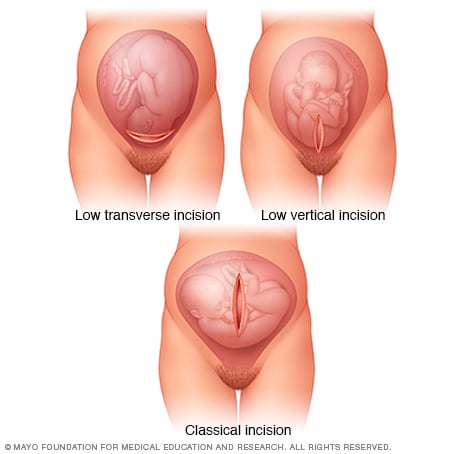
Uterine incisions used during C-sections
A C-section includes an abdominal incision and a uterine incision. After the abdominal incision, the health care provider will make an incision in the uterus. Low transverse incisions are the most common (top left).
A C-section can be done in various ways. But most C-sections involve these steps:
- At home. Your health care provider might ask you to shower at home with an antiseptic soap the night before and the morning of your C-section. Don't shave your pubic hair within 24 hours of your C-section. This can increase the risk of a surgical site infection. If your pubic hair needs to be removed, it will be trimmed by the surgical staff just before surgery.
- At the hospital. Your abdomen will be cleansed. A thin tube (catheter) will likely be placed into your bladder to collect urine. An intravenous line will be placed in a vein in your hand or arm to provide fluid and drugs, including antibiotics to prevent infection.
-
Anesthesia. Most C-sections are done under regional anesthesia, which numbs only the lower part of your body. This allows you to be awake during the procedure. Common choices include a spinal block and an epidural block.
Some C-sections might require general anesthesia. With general anesthesia, you won't be awake during the birth.
During the procedure
A doctor makes surgical incisions in the abdomen and the uterus to deliver the baby.
- Abdominal incision. The doctor makes an incision in the abdominal wall. It's usually done horizontally near the pubic hairline. Or the doctor might make a vertical incision from just below the navel to just above the pubic bone.
- Uterine incision. The uterine incision is then made — usually horizontally across the lower part of the uterus (low transverse incision). Other types of uterine incisions might be used depending on the baby's position within the uterus and whether there are complications, such as placenta previa or preterm delivery.
- Delivery. The baby will be delivered through the incisions. The doctor clears the baby's mouth and nose of fluids, then clamps and cuts the umbilical cord. The placenta is then removed from the uterus, and the incisions are closed with sutures.
If you have regional anesthesia, you're likely to be able to hold the baby shortly after delivery.
After the procedure
A C-section usually requires a hospital stay for 2 to 3 days. Your health care provider will discuss pain relief options with you.
Once the anesthesia begins to wear off, you'll be encouraged to drink fluids and walk. This helps prevent constipation and deep vein thrombosis. Your health care team will monitor your incision for signs of infection. The bladder catheter will likely be removed as soon as possible.
You can start breastfeeding as soon as you're ready, even in the delivery room. Ask your nurse or a lactation consultant to teach you how to position yourself and support your baby so that you're comfortable. Your health care team will select medications for your post-surgical pain with breastfeeding in mind.
When you go home
During the C-section recovery process, discomfort and fatigue are common. To promote healing:
- Take it easy. Rest when possible. Try to keep everything that you and your baby need within reach. For the first few weeks, don't lift more than 25 pounds.
- Use recommended pain relief. To soothe incision soreness, your health care provider might recommend a heating pad and pain medications that are safe for breastfeeding women and their babies. These include ibuprofen (Advil, Motrin IB, others) and acetaminophen (Tylenol, others).
- Wait to have sex. To prevent infection, wait at least six weeks to have sex and don't put anything in your vagina after your C-section.
- Wait to drive. If you're taking narcotics for pain relief, it might take 1 to 2 weeks before you can comfortably apply brakes and twist to check blind spots.
Check your C-section incision for signs of infection. Pay attention to any symptoms. Contact your health care provider if:
- Your incision is red, swollen or leaking discharge
- You have a fever
- You have heavy bleeding
- You have worsening pain
If you have severe mood swings, loss of appetite, overwhelming fatigue and lack of joy in life shortly after childbirth, you might have postpartum depression. Contact your health care provider if you think you might be depressed, especially if your symptoms don't go away, you have trouble caring for your baby or completing daily tasks, or you have thoughts of harming yourself or your baby.
The American College of Obstetricians and Gynecologists recommends that postpartum care be ongoing. Have contact with your health care provider within three weeks after delivery. Within 12 weeks after delivery, see your health care provider for a postpartum evaluation.
During this appointment your health care provider likely will check your mood and emotional well-being, discuss contraception and birth spacing, review information about infant care and feeding, talk about your sleep habits and issues related to fatigue and do a physical exam, including a pap smear if it's due. This might include a check of your abdomen, vagina, cervix and uterus to make sure you're healing well.
Clinical trials
Explore Mayo Clinic studies of tests and procedures to help prevent, detect, treat or manage conditions.