Overview
A congenital heart defect is a problem with the structure of the heart that a child is born with.
Some congenital heart defects in children are simple and don't need treatment. Other congenital heart defects in children are more complex and may require several surgeries performed over a period of several years.
Learning about your child's congenital heart defect can help you understand the condition and know what you can expect in the coming months and years.
What are congenital heart defects? An expert explains
Learn more about CHD from pediatric cardiologist Jonathan Johnson, M.D.
I'm Dr. Jonathan Johnson, a pediatric cardiologist at Mayo Clinic. In this video, we'll cover the basics of congenital heart disease in children. Whether you're looking for answers about your own child's health or that of someone you love, we're here to provide you with the best information available.
Congenital heart disease, also called a defect, refers to one or more problems with the heart structure that are present at birth. These abnormalities occur when the heart or blood vessels don't form correctly in utero. At least eight out of every 1000 infants born in the US each year have a heart defect. That's 40,000 infants every year in this country. Congenital means that the problem was existing or present at birth. But sometimes defects can be identified even before birth. Sometimes they don't show signs until children are older or even into adulthood. Congenital heart disease can involve abnormalities in any of these structures, including the arteries, valves, chambers or the wall separating the chambers of the heart. These defects, depending on the severity and type, can affect the proper flow of blood and oxygen to the lungs and the body. There may be associated heart rhythm problems or the defects may cause the heart to work harder than it should. Some, like a small hole in the heart, can be very simple and cause very few problems with the child's development and health. But other cases, like when babies are born with parts of their hearts missing, require immediate care.
Some congenital heart defects cause no signs or symptoms. Sometimes indications may only appear later in life. And symptoms can also return years after treatments. Symptoms for more serious forms of congenital heart defects may become evident in the first few days or months after birth. You may notice a pale gray or blue skin color called cyanosis. Babies use a lot of calories and effort when they're eating. Thus, eating often brings out symptoms of heart failure, such as rapid breathing or shortness of breath. Poor weight gain caused by the heart defect or by difficulty feeding due to symptoms while feeding, can be a sign of congenital heart disease. Some less serious conditions may not be diagnosed until later in childhood. Signs in older children can include becoming easily short of breath, easily tiring, or fainting during exercise or activity. They may also have swelling in the hands, the ankles and the feet. Your pediatrician may also hear an abnormal heartbeat or abnormal heart sound called a murmur during a checkup. Most of these murmurs are actually innocent, but it's important to check them out.
Some congenital heart defects can be seen on an ultrasound while the baby is still in the womb. In certain extreme cases, treatment may be advised before a baby is even born. This may be done to correct the problem or reduce complications as the child continues to develop. In order to determine if your child has congenital heart disease, your doctor will do a physical exam and listen to their heart with a stethoscope. They'll ask about the child's symptoms and their medical history and any history of heart problems in their families. Then, if needed, they may advise other tests. A pulse oximetry measurement may be performed to estimate the amount of oxygen in the blood. This is a simple test done with a finger sensor. An electrocardiogram, or ECG, can be conducted to record the electrical signals in their heart. This is non-invasive and painless. Your doctor might want to schedule an echocardiogram, which uses sound waves to create an image of the heart. An echocardiogram allows the doctor to see the heart muscle and valves in motion and diagnoses most forms of congenital heart disease. They might be given a chest x-ray, which could reveal issues in the size and the shape of the heart. In some conditions, your doctor may order a cardiac MRI, which uses large magnets to take images of the heart in motion. Your doctor may ask for a cardiac catheterization. For this, a catheter or a small plastic tube placed via a needle into an artery or vein in your leg, arm or neck, and advanced into the different chambers of your heart. This way, doctors can check the blood flow and the pressure inside the heart chambers themselves. Today, doctors use cardiac catheterization methods to close certain kinds of holes in the heart or to place expandable valves.
If your child has congenital heart disease, they will need care throughout their life. However, not every child with congenital heart disease requires active treatment and the defect may pose no harm to their health. Some defects, like a small hole in the heart, may resolve on their own. Some conditions can be treated with medications. These can include blood pressure medications, heart rhythm medications, and medications to help you get rid of excess water in your body. More serious forms of congenital heart diseases may require surgery or other procedures. This may be open-heart or a less invasive type of surgery. And, in cases where repairs aren't an option, a heart transplant may be needed. Doctors try to limit these interventions as much as possible and only recommend them if absolutely needed.
It is important to familiarize yourself with your child's condition. Keep an eye out for worsening or new symptoms, and be aware of any lifestyle adjustments recommended by your cardiologist. As patients get older, it is crucial that they continue care with an adult-focused cardiologist with training in congenital heart disease. Finding out your child has a heart defect is scary and can be for them too, if they're old enough to understand it. But no matter when the diagnosis is made, progress in research and treatment have greatly increased not only survival rates, but overall quality of life for patients living with congenital heart disease. There's a great deal of hope for children with congenital heart disease. And we expect all to have happy childhoods that lead to long, full, productive lives. If you want to learn even more about congenital heart disease in children, watch our other related videos or visit mayoclinic.org. We wish you well.
Types
Symptoms
Serious congenital heart defects usually are noticed soon after birth or during the first few months of life. Signs and symptoms could include:
- Pale gray or blue lips, tongue or fingernails (cyanosis)
- Rapid breathing
- Swelling in the legs, belly or areas around the eyes
- Shortness of breath during feedings, leading to poor weight gain
Less-serious congenital heart defects may not be diagnosed until later in childhood. Signs and symptoms of congenital heart defects in older children may include:
- Easily becoming short of breath during exercise or activity
- Easily tiring during exercise or activity
- Fainting during exercise or activity
- Swelling in the hands, ankles or feet
When to see a doctor
Serious congenital heart defects are often diagnosed before or soon after your child is born. If you notice that your baby has any of the signs or symptoms above, call your health care provider.
If your child has any of the signs or symptoms of less-serious heart defects as he or she grows, call your child's care provider. Your child's provider can let you know if your child's symptoms are due to a heart defect or another medical condition.
Causes
Chambers and valves of the heart
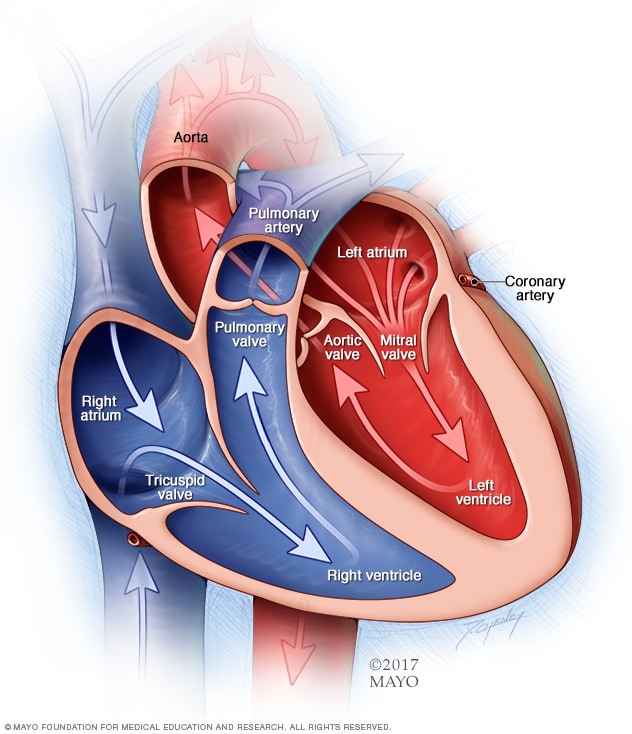
Chambers and valves of the heart
A typical heart has two upper and two lower chambers. The upper chambers, the right and left atria, receive incoming blood. The lower chambers, the more muscular right and left ventricles, pump blood out of the heart. The heart valves, which keep blood flowing in the right direction, are gates at the chamber openings.
To understand the causes of congenital heart defects, it may be helpful to know how the heart typically works.
The heart is divided into four chambers, two on the right and two on the left. To pump blood throughout the body, the heart uses its left and right sides for different tasks.
The right side of the heart moves blood to the lungs through the lung (pulmonary) arteries. In the lungs, blood picks up oxygen then returns to the heart's left side through the pulmonary veins. The left side of the heart then pumps the blood through the body's main artery (aorta) and out to the rest of the body.
How congenital heart defects develop
During the first six weeks of pregnancy, the baby's heart begins to form and starts beating. The major blood vessels that run to and from the heart also begin to develop during this critical time.
It's at this point in a baby's development that congenital heart defects may begin to develop. Researchers aren't sure exactly what causes most of these defects, but they think genetics, certain medical conditions, some medications, and environmental or lifestyle factors, such as smoking, may play a role.
There are many different types of congenital heart defects. They fall into the general categories described below.
Altered connections in the heart or blood vessels
Altered connections allow blood to flow where it usually wouldn't. Holes in the walls between heart chambers are one example of this type of congenital heart defect.
An altered connection can cause oxygen-poor blood to mix with oxygen-rich blood. This lowers the amount of oxygen sent through the body. The change in blood flow forces the heart and lungs to work harder.
Types of altered connections in the heart or blood vessels include:
- Atrial septal defect is a hole between the upper heart chambers (atria).
- Ventricular septal defect is a hole in the wall between the right and left lower heart chambers (ventricles).
- Patent ductus arteriosus (PAY-tunt DUK-tus ahr-teer-e-O-sus) is a connection between the lung artery and the body's main artery (aorta). It's open while a baby is growing in the womb, and typically closes a few hours after birth. But in some babies, it stays open, causing incorrect blood flow between the two arteries.
- Total or partial anomalous pulmonary venous connection occurs when all or some of the blood vessels from the lungs (pulmonary veins) attach to a wrong area or areas of the heart.
Congenital heart valve problems
Heart valves are like doorways between the heart chambers and the blood vessels. Heart valves open and close to keep blood moving in the proper direction. If the heart valves can't open and close correctly, blood can't flow smoothly.
Heart valve problems include valves that are narrowed and don't open completely (stenosis) or valves that don't close completely (regurgitation).
Examples of congenital heart valve problems include:
- Aortic stenosis (stuh-NO-sis). A baby may be born with an aortic valve that has one or two valve flaps (cusps) instead of three. This creates a small, narrowed opening for blood to pass through. The heart must work harder to pump blood through the valve. Eventually, this leads to enlarging of the heart and thickening of the heart muscle.
- Pulmonary stenosis. A defect on or near the pulmonary valve narrows the pulmonary valve opening and slows the blood flow.
- Ebstein anomaly. The tricuspid valve — which is located between the right upper heart chamber (atrium) and the right lower chamber (ventricle) — is malformed and often leaks.
Combination of congenital heart defects
Some infants are born with several congenital heart defects that affect the structure and function of the heart. Very complex heart problems may cause significant changes in blood flow or undeveloped heart chambers.
For example, tetralogy of Fallot (teh-TRAL-uh-jee of fuh-LOW) is a combination of four congenital heart defects:
- A hole in the wall between the heart's lower chambers (ventricles)
- A narrowed passage between the right ventricle and pulmonary artery
- A shift in the connection of the aorta to the heart
- Thickened muscle in the right ventricle
Other examples of complex congenital heart defects are:
- Pulmonary atresia. The valve that lets blood out of the heart to go to the lungs (pulmonary valve) isn't formed correctly. Blood can't travel its usual route to get oxygen from the lungs.
- Tricuspid atresia. The tricuspid valve isn't formed. Instead, there's solid tissue between the right upper heart chamber (atrium) and the right lower chamber (ventricle). This congenital heart defect restricts blood flow and causes the right ventricle to be underdeveloped.
- Transposition of the great arteries. In this serious, rare congenital heart defect, the two main arteries leaving the heart are reversed (transposed). There are two types. Complete transposition of the great arteries is typically noticed during pregnancy or soon after birth. Levo-transposition of the great arteries (L-TGA) is less common. Symptoms may not be noticed right away.
- Hypoplastic left heart syndrome. A major part of the heart fails to develop properly. In hypoplastic left heart syndrome, the left side of the heart hasn't developed enough to effectively pump enough blood to the body.
Risk factors
Most congenital heart defects result from changes that occur early as the baby's heart is developing before birth. The exact cause of most congenital heart defects is unknown, but some risk factors have been identified. Risk factors for congenital heart defects include:
- Rubella (German measles). Having rubella during pregnancy can cause problems in a baby's heart development. A blood test done before pregnancy can determine if you're immune to rubella. A vaccine is available for those who aren't immune.
- Diabetes. Careful control of blood sugar before and during pregnancy can reduce the risk of congenital heart defects in the baby. Diabetes that develops during pregnancy (gestational diabetes) generally doesn't increase a baby's risk of heart defects.
-
Medications. Certain medications taken during pregnancy may cause birth defects, including congenital heart defects. Give your health care provider a complete list of medications you take before trying to become pregnant.
Medications known to increase the risk of congenital heart defects include thalidomide (Thalomid), angiotensin-converting enzyme (ACE) inhibitors, statins, the acne medication isotretinoin (Myorisan, Zenatane, others), some epilepsy drugs and certain anxiety drugs.
- Drinking alcohol during pregnancy. Drinking alcohol during pregnancy increases the risk of congenital heart defects.
- Smoking. If you smoke, quit. Smoking during pregnancy increases the risk of a congenital heart defect in the baby.
- Family history and genetics. Congenital heart defects sometimes run in families (are inherited) and may be associated with a genetic syndrome. Many children with an extra 21st chromosome (Down syndrome) have congenital heart defects. A missing piece (deletion) of genetic material on chromosome 22 also causes heart defects.
Complications
Potential complications of a congenital heart defect include:
- Congestive heart failure. This serious complication may develop in babies who have a significant heart defect. Signs of congestive heart failure include rapid breathing, often with gasping breaths, and poor weight gain.
- Heart infections. Congenital heart defects can increase the risk of infection of the heart tissue (endocarditis), which can lead to new heart valve problems.
- Irregular heart rhythms (arrhythmias). A congenital heart defect or scarring from heart surgery may cause changes in the heart's rhythm.
- Slower growth and development (developmental delays). Children with more-serious congenital heart defects often develop and grow more slowly than do children who don't have heart defects. They may be smaller than other children of the same age. If the nervous system has been affected, a child may learn to walk and talk later than other children.
- Stroke. Although uncommon, some children with congenital heart defects are at increased risk of stroke due to blood clots traveling through a hole in the heart and on to the brain.
- Mental health disorders. Some children with congenital heart defects may develop anxiety or stress because of developmental delays, activity restrictions or learning difficulties. Talk to your child's provider if you're concerned about your child's mental health.
Prevention
Because the exact cause of most congenital heart defects is unknown, it may not be possible to prevent these conditions. If you have a high risk of giving birth to a child with a congenital heart defect, genetic testing and screening may be done during pregnancy.
There are some steps you can take to help reduce your child's overall risk of birth defects such as:
- Get proper prenatal care. Regular checkups with a health care provider during pregnancy can help keep mom and baby healthy.
- Take a multivitamin with folic acid. Taking 400 micrograms of folic acid daily has been shown to reduce birth defects in the brain and spinal cord. It may help reduce the risk of heart defects as well.
- Don't drink or smoke. These lifestyle habits can harm a baby's health. Also avoid secondhand smoke.
- Get a rubella (German measles) vaccine. A rubella infection during pregnancy may affect a baby's heart development. Get vaccinated before trying to get pregnant.
- Control blood sugar. If you have diabetes, good control of your blood sugar can reduce the risk of congenital heart defects.
- Manage chronic health conditions. If you have other health conditions, including phenylketonuria, talk to your health care provider about the best way to treat and manage them.
- Avoid harmful substances. During pregnancy, have someone else do any painting and cleaning with strong-smelling products.
- Check with your provider before taking any medications. Some medications can cause birth defects. Tell your provider about all the medications you take, including those bought without a prescription.