Overview
Dental implant surgery

Dental implant surgery
A dental implant is a metal post that replaces the root portion of a missing tooth. An artificial tooth (crown) is placed on an extension of the post (abutment) on the dental implant, giving you the look of a real tooth.
Dental implant surgery is a procedure that replaces tooth roots with metal, screwlike posts and replaces damaged or missing teeth with artificial teeth that look and function much like real ones. Dental implant surgery can offer a welcome alternative to dentures or bridgework that doesn't fit well and can offer an option when a lack of natural teeth roots don't allow building denture or bridgework tooth replacements.
How dental implant surgery is performed depends on the type of implant and the condition of your jawbone. Dental implant surgery may involve several procedures. The major benefit of implants is solid support for your new teeth — a process that requires the bone to heal tightly around the implant. Because this bone healing requires time, the process can take many months.
Products & Services
Why it's done
Dental implants are surgically placed in your jawbone, where they serve as the roots of missing teeth. Because the titanium in the implants fuses with your jawbone, the implants won't slip, make noise or cause bone damage the way fixed bridgework or dentures might. And the materials can't decay like your own teeth that support regular bridgework can.
In general, dental implants may be right for you if you:
- Have one or more missing teeth
- Have a jawbone that's reached full growth
- Have adequate bone to secure the implants or are able to have a bone graft
- Have healthy oral tissues
- Don't have health conditions that will affect bone healing
- Are unable or unwilling to wear dentures
- Want to improve your speech
- Are willing to commit several months to the process
- Don't smoke tobacco
Risks
Like any surgery, dental implant surgery poses some health risks. Problems are rare, though, and when they do occur they're usually minor and easily treated. Risks include:
- Infection at the implant site
- Injury or damage to surrounding structures, such as other teeth or blood vessels
- Nerve damage, which can cause pain, numbness or tingling in your natural teeth, gums, lips or chin
- Sinus problems, when dental implants placed in the upper jaw protrude into one of your sinus cavities
How you prepare
The planning process for dental implants may involve a variety of specialists, including a doctor who specializes in conditions of the mouth, jaw and face (oral and maxillofacial surgeon), a dentist specializing in treating structures that support the teeth, such as gums and bones (periodontist), a dentist who designs and fits artificial teeth (prosthodontist), or occasionally an ear, nose and throat (ENT) specialist.
Because dental implants require one or more surgical procedures, you must have a thorough evaluation to prepare for the process, including a:
- Comprehensive dental exam. You may have dental X-rays and 3D images taken, and have models made of your teeth and jaw.
- Review of your medical history. Tell your doctor about any medical conditions and any medications you take, including prescription and over-the-counter drugs and supplements. If you have certain heart conditions or orthopedic implants, your doctor may prescribe antibiotics before surgery to help prevent infection.
- Treatment plan. Tailored to your situation, this plan takes into account factors such as how many teeth you need replaced and the condition of your jawbone and remaining teeth.
To control pain, anesthesia options during surgery include local anesthesia, sedation or general anesthesia. Talk to your dental specialist about which option is best for you. Your dental care team will instruct you about eating and drinking before surgery, depending on what type of anesthesia you have. If you're having sedation or general anesthesia, plan to have someone take you home after surgery and expect to rest for the remainder of the day.
What you can expect
Dental implant surgery is usually an outpatient surgery performed in stages, with healing time between procedures. The process of placing a dental implant involves multiple steps, including:
- Damaged tooth removal
- Jawbone preparation (grafting), when needed
- Dental implant placement
- Bone growth and healing
- Abutment placement
- Artificial tooth placement
The entire process can take many months from start to finish. Much of that time is devoted to healing and waiting for the growth of new bone in your jaw. Depending on your situation, the specific procedure done or the materials used, certain steps can sometimes be combined.
When bone grafting is required
Jawbone graft
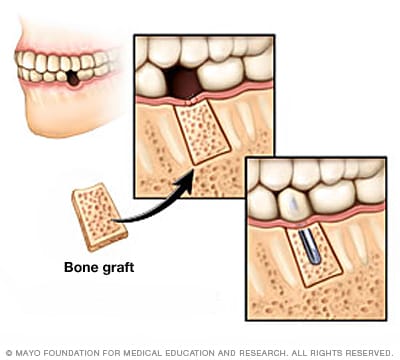
Jawbone graft
Your oral surgeon may need to transplant a small portion of bone — commonly from another site in the upper or lower jawbone — to give the dental implant a solid foundation.
If your jawbone isn't thick enough or is too soft, you may need bone grafting before you can have dental implant surgery. That's because the powerful chewing action of your mouth exerts great pressure on your bone, and if it can't support the implant, the surgery likely would fail. A bone graft can create a more solid base for the implant.
There are several bone graft materials that can be used to rebuild a jawbone. Options may include a natural bone graft, such as from another location in your body, or a synthetic bone graft, such as bone-substitute material that can provide support structures for new bone growth. Talk to your doctor about options that will work best for you.
It may take several months for the transplanted bone to grow enough new bone to support a dental implant. In some cases, you may need only minor bone grafting, which can be done at the same time as the implant surgery. The condition of your jawbone determines how you proceed.
Placing the dental implant
During surgery to place the dental implant, your oral surgeon makes a cut to open your gum and expose the bone. Holes are drilled into the bone where the dental implant metal post will be placed. Since the post will serve as the tooth root, it's implanted deep into the bone.
At this point, you'll still have a gap where your tooth is missing. A type of partial, temporary denture can be placed for appearance, if needed. You can remove this denture for cleaning and while you sleep.
Waiting for bone growth
Once the metal implant post is placed in your jawbone, osseointegration (oss-ee-oh-in-tuh-GRAY-shun) begins. During this process, the jawbone grows into and unites with the surface of the dental implant. This process, which can take several months, helps provide a solid base for your new artificial tooth — just as roots do for your natural teeth.
Placing the abutment
When osseointegration is complete, you may need additional surgery to place the abutment — the piece where the crown will eventually attach. This minor surgery is typically done with local anesthesia in an outpatient setting.
To place the abutment:
- Your oral surgeon reopens your gum to expose the dental implant
- The abutment is attached to the dental implant
- The gum tissue is then closed around, but not over, the abutment
In some cases, the abutment is attached to the dental implant metal post when the post is implanted. That means you won't need an extra surgical step. Because the abutment juts past the gumline, however, it's visible when you open your mouth — and it will be that way until your dentist completes the tooth prosthesis. Some people don't like that appearance and prefer to have the abutment placed in a separate procedure.
After the abutment is placed, your gums must heal for about two weeks before the artificial tooth can be attached.
Choosing your new artificial teeth
Once your gums heal, you'll have more impressions made of your mouth and remaining teeth. These impressions are used to make the crown — your realistic-looking artificial tooth. The crown can't be placed until your jawbone is strong enough to support use of the new tooth.
You and your dental specialist can choose artificial teeth that are removable, fixed or a combination of both:
- Removable. This type is similar to a conventional removable denture and can be a partial or full denture. It contains artificial white teeth surrounded by pink plastic gum. It's mounted on a metal frame that's attached to the implant abutment, and it snaps securely into place. It can be easily removed for repair or daily cleaning.
- Fixed. In this type, an artificial tooth is permanently screwed or cemented onto an individual implant abutment. You can't remove the tooth for cleaning or during sleep. Most of the time, each crown is attached to its own dental implant. However, because implants are exceptionally strong, several teeth can be replaced by one implant if they're bridged together.
After the procedure
Whether you have dental implant surgery in one stage or multiple stages, you may experience some of the typical discomforts associated with any type of dental surgery, such as:
- Swelling of your gums and face
- Bruising of your skin and gums
- Pain at the implant site
- Minor bleeding
You may need pain medications or antibiotics after dental implant surgery. If swelling, discomfort or any other problem gets worse in the days after surgery, contact your oral surgeon.
After each stage of surgery, you may need to eat soft foods while the surgical site heals. Typically, your surgeon will use stitches that dissolve on their own. If your stitches aren't self-dissolving, your doctor removes them.
Results
Most dental implants are successful. Sometimes, however, the bone fails to fuse sufficiently to the metal implant. Smoking, for example, may contribute to implant failure and complications.
If the bone fails to fuse sufficiently, the implant is removed, the bone is cleaned up, and you can try the procedure again in about three months.
You can help your dental work — and remaining natural teeth — last longer if you:
- Practice excellent oral hygiene. Just as with your natural teeth, keep implants, artificial teeth and gum tissue clean. Specially designed brushes, such as an interdental brush that slides between teeth, can help clean the nooks and crannies around teeth, gums and metal posts.
- See your dentist regularly. Schedule dental checkups to ensure the health and proper functioning of your implants and follow the advice for professional cleanings.
- Avoid damaging habits. Don't chew hard items, such as ice and hard candy, which can break your crowns — or your natural teeth. Avoid tooth-staining tobacco and caffeine products. Get treatment if you grind your teeth.
Jan. 29, 2019