Overview
DiGeorge syndrome, also known as 22q11.2 deletion syndrome, is a condition caused when a small part of chromosome 22 is missing. This deletion causes several body systems to develop poorly.
The term 22q11.2 deletion syndrome covers terms once thought to be different conditions. These terms include DiGeorge syndrome, velocardiofacial (vel-oh-cahr-dee-oh-fay-shell) syndrome and other conditions caused by the same missing part of chromosome 22. But features may vary slightly.
Medical problems commonly related to 22q11.2 deletion syndrome include heart problems, lowered immunity, a cleft palate, complications from low levels of calcium, various eye issues and autoimmune disorders. Complications also include hearing loss, skeletal differences, kidney and genital differences, and delayed development with behavioral and emotional problems.
The number and severity of symptoms related to 22q11.2 deletion syndrome vary. But specialists in various fields need to treat almost everyone with this syndrome.
Products & Services
Symptoms
Symptoms of DiGeorge syndrome can vary based on what body systems are affected and the severity of the problems. Some symptoms may be clear at birth, but others may not appear until later in infancy or as a young child, or as an adult.
Symptoms of DiGeorge syndrome may include:
- Heart issues, such as problems with the structure of the heart and vessels, or a heart murmur and bluish skin because of poor circulation of blood, also known as cyanosis.
- Frequent infections.
- Distinctive facial features, such as an underdeveloped chin, ears that look different, wide-set eyes, hooded eyes and an enlarged nose tip. Asymmetric crying facies also may be present. This is when muscles on one side of the mouth don't develop fully, causing that side of the mouth to droop when crying, though the face looks balanced at rest.
- A gap in the roof of the mouth, also known as a cleft palate, or other problems with the palate.
- A hard time feeding, failure to gain weight or stomach problems.
- Hearing loss.
- Poor muscle tone.
- Kidney problems.
- Poor vision and other eye problems.
- Low levels of calcium in the blood.
- Scoliosis.
Other symptoms may include:
- Delayed growth.
- Delayed development, such as delays in rolling over, sitting up or other infant milestones.
- Delayed speech development or nasal-sounding speech.
- Learning delays or disabilities.
- Behavioral problems.
When to see a doctor
Other conditions may cause symptoms like 22q11.2 deletion syndrome. It's important to get the right diagnosis quickly if your child shows any symptoms listed above.
Healthcare professionals may suspect 22q11.2 deletion syndrome:
- At birth. If a severe heart problem, cleft palate or other signs typical of 22q11.2 deletion syndrome are clear at birth, tests likely will be done before your child leaves the hospital.
- At well-baby visits. Illnesses or conditions that are typical of 22q11.2 deletion syndrome may become clear over time. Your child's healthcare professional may see issues during regularly scheduled well-baby visits or annual checkups.
Causes
Each person has two copies of chromosome 22 — one inherited from each parent. If a person has DiGeorge syndrome, one copy of chromosome 22 is missing a segment that includes an estimated 30 to 40 genes. Many of these genes haven't been clearly identified and aren't well understood. The region of chromosome 22 that's deleted is known as 22q11.2.
The deletion of genes from chromosome 22 usually occurs as a random event in the father's sperm or in the mother's egg. Or it may occur early when the baby is developing. Rarely, the deletion is passed to a child from a parent who also has a deletion in chromosome 22 but may have fewer or mild symptoms.
Risk factors
Babies who are missing a portion of chromosome 22, specifically a region known as 22q11.2, are most at risk of DiGeorge syndrome. This missing portion causes several body systems to develop poorly.
Complications
Ventricular septal defect

Ventricular septal defect
A ventricular septal defect (VSD) is a hole in the heart that's present at birth (congenital heart defect). The hole is between the lower heart chambers (right and left ventricles). It allows oxygen-rich blood to move back into the lungs instead of being pumped to the rest of the body.
Truncus arteriosus

Truncus arteriosus
In truncus arteriosus, one large vessel comes out of the heart, instead of two separate ones. There's also usually a hole in the wall between the lower heart chambers, called the ventricles. The hole is called a ventricular septal defect. In truncus arteriosus, oxygen-rich blood, shown in red, and oxygen-poor blood, shown in blue, mix together. The mixed blood is shown in purple. It doesn't contain enough oxygen for the body's needs.
Tetralogy of Fallot
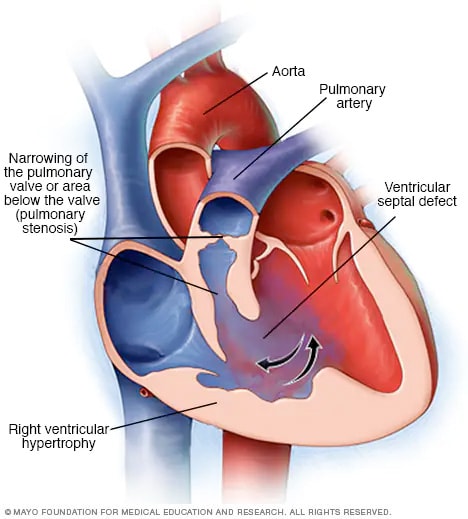
Tetralogy of Fallot
Tetralogy of Fallot is a combination of four heart changes present at birth. There is a hole in the heart called a ventricular septal defect. There also is a narrowing of the pulmonary valve or other area along the pathway between the heart and lungs. Narrowing of the pulmonary valve is called pulmonary stenosis. The body's main artery, called the aorta, is misplaced. The lower right heart chamber wall is thickened, a condition called right ventricular hypertrophy. Tetralogy of Fallot changes how blood flows through the heart and to the rest of the body.
Parathyroid glands

Parathyroid glands
The four tiny parathyroid glands, which lie near the thyroid, make the parathyroid hormone. The hormone plays a role in controlling levels of the minerals calcium and phosphorus in the body.
Cleft palate
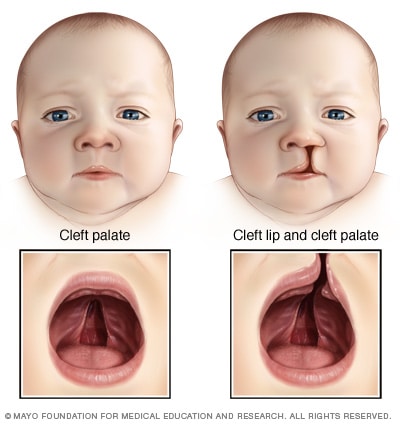
Cleft palate
A cleft palate is an opening or split in the roof of the mouth that occurs when the tissue doesn't fuse together during development in the womb. A cleft palate often includes a split (cleft) in the upper lip (cleft lip) but can occur without affecting the lip.
Parts of the immune system
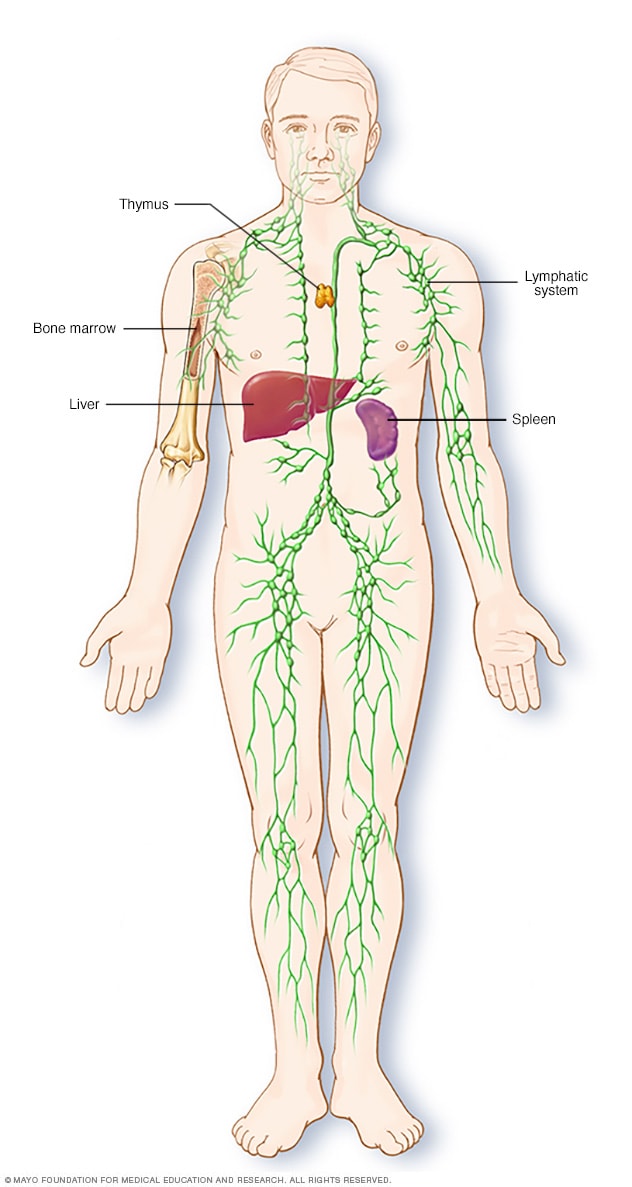
Parts of the immune system
The lymphatic system is part of the body's immune system, which protects against infection and disease. The lymphatic system includes the spleen, thymus, lymph nodes and lymph channels, as well as the tonsils and adenoids.
The portions of chromosome 22 missing in DiGeorge syndrome affect the development of several body systems. As a result, the condition can cause several errors during fetal development.
- Heart issues. 22q11.2 deletion syndrome often causes heart problems that could lead to too little oxygen-rich blood. For example, problems may include a hole between the lower chambers of the heart, also known as a ventricular septal defect. Or there may be only one large vessel rather than two vessels leading out of the heart, also known as truncus arteriosus. Or there may be four problems with heart structure, also known as tetralogy of Fallot.
- Hypoparathyroidism. The four parathyroid glands in the neck regulate the levels of calcium and phosphorus in the body. 22q11.2 deletion syndrome can cause parathyroid glands to be smaller than usual and produce too little parathyroid hormone. This leads to hypoparathyroidism. This condition results in low levels of calcium and high levels of phosphorus in the blood.
- Thymus gland dysfunction. The thymus gland, which is beneath the breastbone, is where T cells — a type of white blood cell — mature. Mature T cells help fight infections. In children with 22q11.2 deletion syndrome, the thymus gland may be small or missing. This leads to poor immune function and frequent, severe infections.
- Cleft palate. A common condition of 22q11.2 deletion syndrome is a cleft palate, which is an opening in the roof of the mouth, with or without a cleft lip. Other, less visible problems with the structure of the palate can make it hard to swallow or make certain sounds in speech.
- Distinct facial features. A number of particular facial features may be present in some people with 22q11.2 deletion syndrome. These may include small, low-set ears, short width of eye openings (palpebral fissures), hooded eyes, a relatively long face, an enlarged nose tip (bulbous), or a short or flattened groove in the upper lip.
- Learning, behavioral and mental health problems. 22q11.2 deletion syndrome may cause problems with development and function of the brain, resulting in learning, social, developmental or behavioral problems. Delays in toddler speech development and finding it hard to learn are common. Some children develop attention-deficit/hyperactivity condition (ADHD) or autism spectrum disorder. Later in life, the risk of depression, anxiety and other mental health conditions is higher.
- Autoimmune conditions. People with 22q11.2 deletion syndrome also may have a greater risk of getting autoimmune conditions, such as rheumatoid arthritis or Graves' disease.
- Other problems. Many medical conditions may be related to 22q11.2 deletion syndrome, such as hearing problems, eye problems and poor kidney function.
Prevention
In some cases, an affected parent may pass DiGeorge syndrome to a child. If you're worried about a family history of 22q11.2 deletion syndrome or if you already have a child with the syndrome, you may want to see a doctor who specializes in genetic conditions. This doctor is called a geneticist. Or you may want to see a genetic counselor to help plan future pregnancies.
Jan. 13, 2024