Overview
Female reproductive system
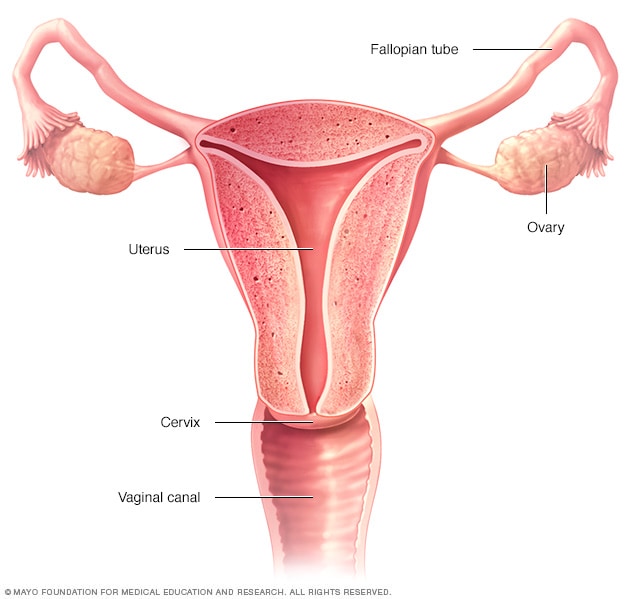
Female reproductive system
The ovaries, fallopian tubes, uterus, cervix and vagina (vaginal canal) make up the female reproductive system.
Dilation and curettage (D&C) is a procedure to remove tissue from inside your uterus. Health care professionals perform dilation and curettage to diagnose and treat certain uterine conditions — such as heavy bleeding — or to clear the uterine lining after a miscarriage or abortion.
In a dilation and curettage, small instruments or a medication is used to open (dilate) the lower, narrow part of your uterus (cervix). Next, a surgical instrument called a curette, which can be a sharp instrument or suction device, is used to remove uterine tissue.
Products & Services
Why it's done
Dilation and curettage is used to diagnose or treat a uterine condition.
To diagnose a condition
Before doing a D&C, your health care team might recommend a procedure called endometrial biopsy or endometrial sampling to diagnose a condition. Endometrial sampling might be done if:
- You have unusual uterine bleeding.
- You have bleeding after menopause.
- You have unusual endometrial cells, which are discovered during a routine test for cervical cancer.
To perform the test, a health care professional collects a tissue sample from the lining of your uterus, also called the endometrium, and sends the sample to a lab for testing. The test can check for:
- Endometrial intraepithelial hyperplasia — a precancerous condition in which the uterine lining becomes too thick
- Uterine polyps
- Uterine cancer
If more information is needed, you then might need a D&C, which is usually done in an operating room.
To treat a condition
Hysteroscopy

Hysteroscopy
During hysteroscopy (his-tur-OS-kuh-pee), a thin, lighted instrument provides a view of the inside of the uterus. This instrument also is called a hysteroscope.
When performing a D&C to treat a condition, a doctor removes the contents from inside your uterus, not just a small tissue sample. This might be done to:
- Prevent infection or heavy bleeding by clearing tissues that remain in the uterus after a miscarriage or abortion.
- Remove a tumor that forms instead of a typical pregnancy. This is also called a molar pregnancy.
- Treat excessive bleeding after delivery by clearing out any placenta that remains in the uterus.
- Remove cervical or uterine polyps, which are usually noncancerous, or benign.
A D&C might be combined with another procedure called hysteroscopy. During hysteroscopy, a doctor inserts a slim instrument with a light and camera on the end into your vagina, through your cervix and into your uterus.
Your doctor then views the lining of your uterus on a screen, checking for areas that look unusual. Your doctor also checks for polyps and takes tissue samples as needed. During a hysteroscopy, uterine polyps and fibroid tumors can be removed.
At times, a hysteroscopy might be done combined with an endometrial biopsy before a full D&C procedure.
Risks
Complications from dilation and curettage are rare. However, there are risks, including:
-
Perforation of the uterus. This occurs when a surgical instrument pokes a hole in the uterus. This happens more often in women who were recently pregnant and in women who have gone through menopause.
Most perforations heal on their own. However, if a blood vessel or other organ is damaged, a second procedure might be needed to repair it.
- Damage to the cervix. If the cervix is torn during the D&C, your doctor can apply pressure or medicine to stop the bleeding or can close the wound with stitches (sutures). This might be prevented if the cervix is softened with medication before the D&C.
-
Scar tissue on the uterine wall. Rarely, a D&C results in development of scar tissue in the uterus, a condition known as Asherman's syndrome. Asherman's syndrome happens most often when the D&C is done after a miscarriage or delivery.
This can lead to unusual, absent or painful menstrual cycles, future miscarriages and infertility. It can often be treated with surgery.
- Infection. Infection after a D&C is rare.
Contact your health care team if after a D&C you have:
- Bleeding that's heavy enough that you need to change pads every hour.
- Lasting dizziness or lightheadedness.
- Fever.
- Cramps lasting more than 48 hours.
- Pain that gets worse instead of better.
- Foul-smelling discharge from the vagina.
How you prepare
Dilation and curettage can be done in a hospital, clinic or health care professional's office, usually as an outpatient procedure.
Before the procedure:
- Follow your care team's instructions on limiting food and drink.
- Arrange for someone to take you home because you may be drowsy after the anesthesia wears off.
- Allow time for the procedure and a few hours of recovery afterward.
In some cases, you might start to have your cervix dilated a few hours or even a day before the procedure. This helps your cervix open gradually and is usually done when your cervix needs to be dilated more than in a standard D&C, such as during pregnancy terminations or with certain types of hysteroscopy.
To promote dilation, your doctor may use a medication called misoprostol (Cytotec) — given orally or vaginally — to soften the cervix. Another dilation method is to insert a slender rod made of laminaria into your cervix. The laminaria gradually expands by absorbing fluid in your cervix, causing your cervix to open.
What you can expect
During the procedure
Dilation and curettage (D&C)
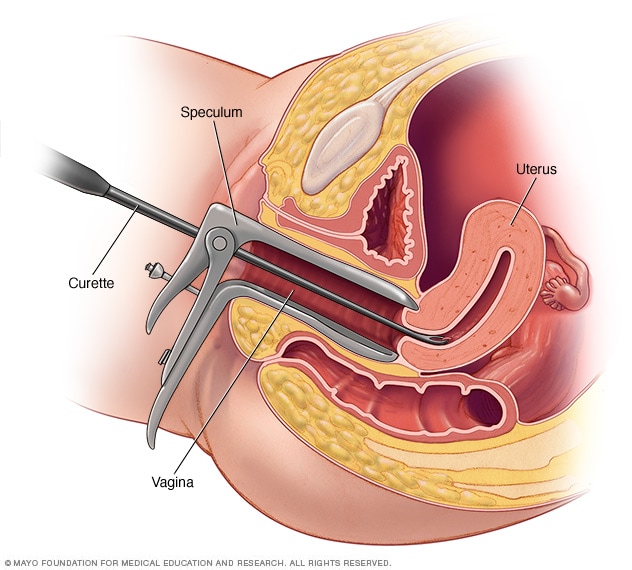
Dilation and curettage (D&C)
During a dilation and curettage procedure, also called D&C, a vaginal speculum is used to hold the walls of the vagina apart. Then a series of rods of increasing thickness, called dilators, are inserted to open the cervix slowly. This allow access to the uterus. Next, a long, thin tool called a curette is inserted through the cervix into the uterus. With this tool, the tissue lining the inside of the uterus is carefully removed.
For dilation and curettage, you'll receive anesthesia. The choice of anesthesia depends on the reason for the D&C and your medical history.
During the procedure:
- You lie on your back on an exam table while your heels rest in supports called stirrups.
- Your doctor inserts an instrument called a speculum into your vagina, as during a Pap test, to see your cervix.
- Your doctor inserts a series of increasingly thick rods into your cervix to slowly dilate it until it's open enough.
- Your doctor removes the dilation rods and inserts a spoon-shaped instrument with a sharp edge or a suction device and removes uterine tissue.
Because you're either unconscious or sedated during a D&C, you shouldn't feel any discomfort.
After the procedure
You'll likely spend a few hours in a recovery room after the D&C so that you can be monitored for heavy bleeding or other complications. This also gives you time to recover from the effects of anesthesia.
Typical side effects of a D&C can last a few days and include:
- Mild cramping
- Spotting or light bleeding
For discomfort from cramping, your care team might suggest taking ibuprofen (Advil, Motrin IB, others) or another medication.
You should be able to resume your activities within a day or two.
To prevent infection, don't put anything in your vagina until your care team says it's OK. Ask when you can use tampons and resume sexual activity.
Your uterus must build a new lining after a D&C, so your next period might be early or late. If you had a D&C because of a miscarriage, and you want to become pregnant, talk with your care team about when it's safe to start trying again.
Results
Your health care team will discuss the results of the procedure with you after the D&C or at a follow-up appointment.
Nov. 07, 2023