Overview
EEG brain activity
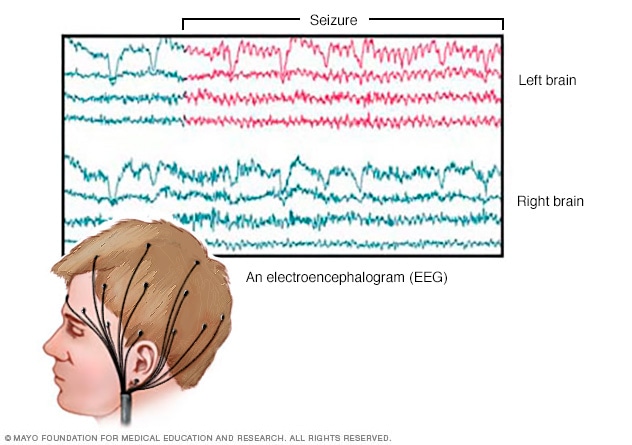
EEG brain activity
An EEG records the electrical activity of the brain via electrodes affixed to the scalp. EEG results show changes in brain activity that may be useful in diagnosing brain conditions, especially epilepsy and other conditions that cause seizures.
An electroencephalogram (EEG) is a test that measures electrical activity in the brain using small, metal discs (electrodes) attached to the scalp. Brain cells communicate via electrical impulses and are active all the time, even during asleep. This activity shows up as wavy lines on an EEG recording.
An EEG is one of the main diagnostic tests for epilepsy. An EEG can also play a role in diagnosing other brain disorders.
Why it's done
An EEG can find changes in brain activity that might be useful in diagnosing brain disorders, especially epilepsy or another seizure disorder. An EEG might also be helpful for diagnosing or treating:
- Brain tumors
- Brain damage from head injury
- Brain dysfunction that can have a variety of causes (encephalopathy)
- Sleep disorders
- Inflammation of the brain (herpes encephalitis)
- Stroke
- Sleep disorders
- Creutzfeldt-Jakob disease
An EEG might also be used to confirm brain death in someone in a persistent coma. A continuous EEG is used to help find the right level of anesthesia for someone in a medically induced coma.
More Information
Risks
EEGs are safe and painless. Sometimes seizures are intentionally triggered in people with epilepsy during the test, but appropriate medical care is provided if needed.
How you prepare
Food and medications
Take your usual medications unless instructed otherwise.
Other precautions
- Wash your hair the night before or the day of the test, but don't use conditioners, hair creams, sprays or styling gels. Hair products can make it harder for the sticky patches that hold the electrodes to adhere to your scalp.
- If you're supposed to sleep during your EEG, your health care provider might ask you to sleep less or avoid sleep the night before your EEG.
What you can expect
During the test
EEG electrodes
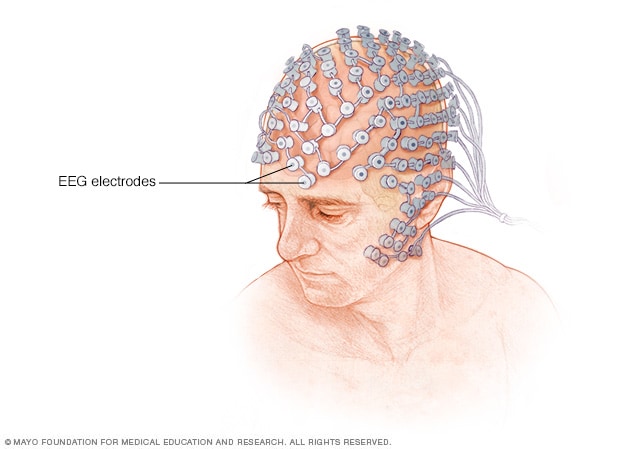
EEG electrodes
During an EEG, flat metal discs (electrodes) are attached to the scalp. In a high-density EEG, shown here, the electrodes are close together. The electrodes are connected to the EEG machine with wires. Some people wear an elastic cap fitted with electrodes instead of having the adhesive applied to their scalps.
You'll feel little or no discomfort during an EEG. The electrodes don't transmit any sensations. They just record your brain waves.
Here are some things you can expect to happen during an EEG:
- A technician measures your head and marks your scalp with a special pencil to indicate where to attach the electrodes. These spots on your scalp might be scrubbed with a gritty cream to improve the quality of the recording.
-
A technician attaches discs (electrodes) to your scalp using a special adhesive. Sometimes, an elastic cap fitted with electrodes is used instead. The electrodes are connected with wires to an instrument that amplifies the brain waves and records them on computer equipment.
Once the electrodes are in place, an EEG typically takes between 20 and 40 minutes. Testing for certain conditions requires you to sleep during the test. In that case, the test can be longer.
- You relax in a comfortable position with your eyes closed during the test. At various times, the technician might ask you to open and close your eyes, perform a few simple calculations, read a paragraph, look at a picture, breathe deeply for a few minutes, or look at a flashing light.
- Video is routinely recorded during the EEG. Your body motions are captured by a video camera while the EEG records your brain waves. This combined recording can help your doctor diagnose and treat your condition.
Ambulatory EEGs (aEEGs) allow for longer monitoring outside an office or a hospital setting. But these types of EEGs aren't always an option. This test can record brain activity over several days, which increases the chances of recording during seizure activity. However, compared with inpatient video EEG monitoring, an ambulatory EEG is not as good at determining the difference between epileptic seizures and nonepileptic seizures.
After the test
The technician removes the electrodes or cap. If you didn't have a sedative, you should feel no side effects after the procedure. You should be able to return to your typical routine.
If you used a sedative, it will take time for the medication to begin to wear off. Arrange to have someone drive you home. Once you're at home, rest and don't drive for the rest of the day.
Results
Doctors trained to analyze EEGs interpret the recording and send the results to the doctor who ordered the EEG. You might need to schedule an office appointment to discuss the results of the test.
If possible, bring along a family member or friend to the appointment to help you remember the information you're given.
Write down questions to ask your doctor, such as:
- Based on the results, what are my next steps?
- What follow-up, if any, do I need?
- Are there factors that might have affected the results of this test in some way?
- Will I need to repeat the test?
Clinical trials
Explore Mayo Clinic studies of tests and procedures to help prevent, detect, treat or manage conditions.
The Mayo Clinic experience and patient stories
Our patients tell us that the quality of their interactions, our attention to detail and the efficiency of their visits mean health care like they've never experienced. See the stories of satisfied Mayo Clinic patients.