How fit are you? See how you measure up
Ready to start a fitness program? Measure your fitness level with a few simple tests. Then use the results to set fitness goals and track your progress.
By Mayo Clinic Staff
You might have some idea of how fit you are. But knowing for sure can help you set good fitness goals, see your progress and stay motivated. Once you know your starting point, you can plan where you want to go. Get started with the simple tests below.
Gather your tools
Most often, measures of fitness involve these key areas:
- Aerobic fitness, which involves how well the heart uses oxygen.
- Muscle strength and endurance, which involve how hard and long muscles can work.
- Flexibility, which is how able joints are to move through their full range of motion.
- Body composition, which involves how much fat, bone and muscle are in the body.
To do your assessment, you need:
- A stopwatch or a watch that can measure seconds.
- A cloth measuring tape.
- A scale.
- Someone to help you record your scores and count how many times you repeat something.
You'll also need a pencil or pen and paper to record your scores as you finish each part of the test. You can record your scores in a notebook or journal. Or you can save them in a spreadsheet or another electronic format.
Aerobic fitness: Heart rate at rest
Checking pulse over the carotid artery
Checking pulse over the carotid artery

Checking pulse over the carotid artery
To check your pulse over your carotid artery, place your index and third fingers on your neck to the side of your windpipe. When you feel your pulse, look at your watch and count the number of beats in 15 seconds. Multiply this number by four to get your heart rate per minute.
Your heart rate at rest is a measure of heart health and fitness. For most adults, a healthy heart rate is between 60 to 100 beats per minute.
To check your pulse at the blood vessel in the neck called the carotid artery, place your index and third fingers on your neck to the side of your windpipe.
To check your pulse at your wrist, place two fingers between the bone and the tendon over the blood vessel found on the thumb side of the wrist, called the radial artery.
Take your pulse for 15 seconds. Multiply this number by four to find out your beats per minute. Let's say you count 20 beats in 15 seconds. Multiply 20 by four for a total of 80 beats per minute.
Aerobic fitness: Target heart rate zone
The target heart rate zone is a heart rate range that gives your heart and lungs a good workout. This zone ranges from 50% to 85% of the maximum heart rate (MHR) for your age. Aim for 50% to 70% of MHR when you do moderately intense activities and 70% to 85% of MHR when you do vigorous activities.
You can use the target heart rate zone as a guide to see how hard you're exercising. It's okay if you don't reach your target zone. Any activity is good for your health. If you're on the lower end of your target heart rate zone, you can try to increase your effort little by little to get more from your workout.
If you exercise regularly, you can stop briefly to check your heart rate at times during an aerobic workout. If you don't exercise regularly, you can do a simple test by checking your heart rate after a brisk 10-minute walk.
Target heart rate zone
| Age |
Target heart rate zone: Beats per minute |
Maximum heart rate: Beats per minute |
| 25 |
100-170 |
200 |
| 35 |
93-157 |
185 |
| 45 |
88-149 |
175 |
| 55 |
83-140 |
165 |
| 65 |
78-132 |
155 |
Aerobic fitness: Running or jogging test
Another way to test your aerobic fitness is to time yourself on a 1.5-mile (2.4-kilometer) run or jog. The following times show a good fitness level based on age and sex. A lower time most often means better aerobic fitness. A higher time suggests a need to do better.
Good fitness results based on timing of 1.5-mile run
| Age |
Women: Time in minutes |
Men: Time in minutes |
| 25 |
13 |
11 |
| 35 |
13.5 |
11.5 |
| 45 |
14 |
12 |
| 55 |
16 |
13 |
| 65 |
17.5 |
14 |
Muscular strength and endurance: Pushup test
Measuring muscular fitness
Measuring muscular fitness
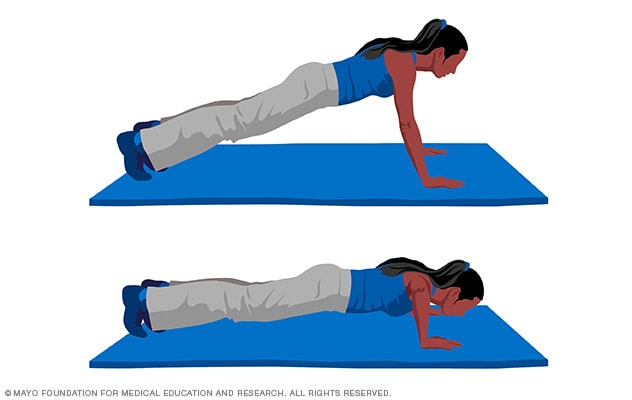
Measuring muscular fitness
Pushups can help you measure how strong your muscles are.
Pushups can help you measure muscular strength and endurance. If you're starting a fitness program, you can do pushups on your knees. If you can, do classic pushups. Follow these steps for both types:
- Lie facedown on the floor with your elbows bent and your palms next to your shoulders.
- Keep your back straight. Push up with your arms until your arms are at full length.
- Lower your body until your chin touches the floor.
- Do as many pushups as you can until you need to rest.
The following counts show a good fitness level based on age and sex. If your pushup count is below the target number, use the target as a goal to work toward. Counts above the targets mean better fitness.
Good fitness results for pushup counts
| Age |
Women: Number of pushups |
Men: Number of pushups |
| 25 |
20 |
28 |
| 35 |
19 |
21 |
| 45 |
14 |
16 |
| 55 |
10 |
12 |
| 65 |
10 |
10 |
Body composition: Waist circumference
If the size of your waist, called the circumference, is greater than your hips, you carry more weight above the hips. This means you have a higher risk of heart disease and type 2 diabetes.
The risk is even greater for women with waist sizes of 35 inches (89 centimeters) or more. For men, the risk is higher with waist sizes of 40 inches (102 centimeters) or more.
With a cloth measuring tape, measure your waist just above the hipbones.
Body composition: Body mass index
Your body mass index (BMI) shows whether you have a healthy amount of body fat. You can find your BMI with a BMI table or online calculator.
To do the math yourself, divide your weight in pounds by your height in inches squared. Then multiply by 703. Or divide your weight in kilograms by your height in meters squared. To get your height in meters, divide your height in centimeters by 100.
The following shows what your BMI results mean.
Interpretation of BMI results
| BMI |
Weight status |
| Below 18.5 |
Underweight |
| 18.5-24.9 |
Normal weight |
| 25.0-29.9 |
Overweight |
| 30 and above |
Obesity |
Stay active
The results of these fitness tests can help you set goals for staying active and getting more fit. For most healthy adults, the Department of Health and Human Services recommends these exercise guidelines:
- Aerobic activity. Get at least 150 minutes of moderate aerobic activity. Or get at least 75 minutes of vigorous aerobic activity a week. You can also get an equal mix of the two types. Aim to exercise most days of the week.
- Strength training. Do strength training exercises for all major muscle groups at least two times a week. One set of each exercise is enough for health and fitness benefits. Use a weight or resistance level heavy enough to tire your muscles after about 12 to 15 repetitions.
Moderate aerobic activity includes:
- Walking at a good pace.
- Water aerobics.
- Bicycling slower than 10 miles an hour on mostly level ground.
- Pushing a lawn mower, gardening or doing home repair.
Vigorous aerobic activity includes:
- Running.
- Swimming laps.
- Fast bicycling or biking hills.
- Jumping rope.
- Playing singles tennis.
Muscle-strengthening exercises include:
- Lifting weights or using resistance bands.
- Calisthenics that use body weight for resistance.
- Heavy gardening or yardwork.
Keep track of your progress
Keep track of your progress in building fitness. Take the same measurements about six weeks after you begin an exercise program. Then take them once in a while.
Each time you repeat your tests, take pride in your progress. Then increase your fitness goals. Share your results with your healthcare professional or personal trainer for more guidance.
Jan. 18, 2024
- Target heart rates chart. American Heart Association. https://www.heart.org/en/healthy-living/fitness/fitness-basics/target-heart-rates. Accessed Aug. 3, 2023.
- Physical Activity Guidelines for Americans. 2nd ed. U.S. Department of Health and Human Services. https://health.gov/our-work/physical-activity/current-guidelines. Accessed Aug. 3, 2023.
- AskMayoExpert. Physical activity (adult). Mayo Clinic; 2022.
- Assessing your weight and health risk. National Heart, Lung, and Blood Institute. https://www.nhlbi.nih.gov/health/educational/lose_wt/risk.htm. Accessed Aug. 3, 2023.
- About adult BMI. Centers for Disease Control and Prevention. https://www.cdc.gov/healthyweight/assessing/bmi/adult_bmi/index.html. Accessed Aug. 8, 2023.
- Feito Y, et al., eds. ACSM's Fitness Assessment Manual. 6th ed. Wolters Kluwer Health Lippincott Williams & Wilkins; 2022. Accessed Aug. 8, 2023.
- Physical Fitness Assessments and Norms for Adults and Law Enforcement. The Cooper Institute; 2013.