Germs: Understand and protect against bacteria, viruses and infections
Learn how germs work and what you can do to protect yourself.
By Mayo Clinic Staff
Germs live everywhere. There are germs, also called microbes, in the air; on food, plants and animals; and in the soil and water. Germs are on just about every surface, including the human body.
Most germs cause no harm. The immune system protects against things that cause infections, called infectious agents. But some germs keep changing to get past the immune system's defenses. Knowing how germs work can increase your chances of not getting infections.
Infectious agents: From bacteria to worms
Types of infectious agents
Types of infectious agents
Types of infectious agents
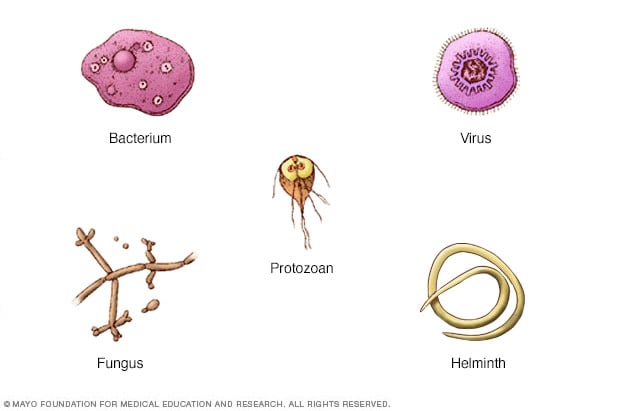
Infectious agents come in many shapes and sizes. Bacteria and protozoans are microscopic one-celled organisms. Viruses are even smaller. Fungi grow like plants. Helminths resemble worms.
Infectious agents come in many shapes and sizes. They include:
- Bacteria.
- Viruses.
- Fungi.
- Protozoans.
- Helminths.
Bacteria
Bacteria are one-celled life forms called organisms that can be seen only with a microscope.
Not all bacteria are harmful. Some bacteria that live in the body are helpful. For instance, some bacteria that live in the intestines, help digest food, destroy disease-causing organisms and provide nutrients.
But bacteria may also cause illness. Many disease-causing bacteria make powerful chemicals called toxins that damage cells and make you ill. Other bacteria can get into and damage tissues. Some infections caused by bacteria include:
- Strep throat.
- Tuberculosis.
- Urinary tract infections.
Viruses
Viruses are much smaller than cells. In fact, viruses are just capsules that hold genetic material. To reproduce, viruses invade cells in the body. They take over the process that makes cells work. In time, host cells often are destroyed during this process.
Viruses are responsible for causing many diseases, including:
- Common cold.
- Influenza.
- Measles.
- Chickenpox and shingles.
- Coronavirus disease 2019, also called COVID-19.
Antibiotics kill or block activities bacteria need to live or grow, but antibiotics don't work on viruses. Medicine that treats viral infections is called an antiviral. These medicines usually stop a virus from making copies of itself. They also may stop a virus from going into or leaving a cell.
Fungi
There are many types of fungi. People eat some of them. Mushrooms are fungi. So are the molds that form the blue or green veins in some types of cheese. And yeast is a type of fungus needed to make most breads.
Other fungi can cause illness. One example is the yeast candida. Candida can cause an infection of the mouth and throat called thrush. Thrush happens in infants and in people taking antibiotics or who have weakened immune systems. Fungi also cause skin conditions such as athlete's foot and ringworm.
Protozoans
Protozoans are single-celled life forms that act like tiny animals. They hunt and gather other microbes for food. Many harmless protozoans live in the intestinal tract. Others cause diseases, such as:
- Giardiasis.
- Malaria.
- Toxoplasmosis.
Protozoans often spend part of their life cycles outside of humans or other hosts. They live in food, soil, water or insects. Some protozoans enter the body through food or water. Others, such as the malaria protozoans, enter the body through mosquito bites.
Helminths
Helminths are among the larger parasites. The word helminth comes from the Greek word for worm. If these parasites or their eggs enter the body, they settle in the intestinal tract, lungs, liver, skin or brain. There, they live off the body's nutrients. Helminths include tapeworms and roundworms.
Understanding infection versus disease
There's a difference between infection and disease. Infection, often the first step in getting a disease, occurs when bacteria, viruses or other microbes that cause disease enter the body and begin to multiply. Disease happens when the infection damages cells in the body. Then symptoms of an illness appear.
In response to infection, the immune system becomes active. White blood cells, antibodies and more goes to work to rid the body of what's causing the infection. For instance, in clearing out the common cold, the body might react with fever, coughing and sneezing.
Warding off germs and infection
What's the best way to stay disease-free? Prevent infections. You can prevent many infections and avoid spreading infections by taking simple steps like these:
- Stay away from people who are sick.
- Cover coughs and sneezes.
- Don't touch your face.
- Stay home if you're sick.
- Clean and disinfect surfaces that are touched often.
- Stay away from germy, called contaminated, food and water.
You also can prevent infections through:
-
Hand-washing. Hand-washing is one of the easiest and best ways to protect yourself from germs and most infections. Wash your hands with soap and water for at least 20 seconds. Wash your hands before making or eating food, after coughing or sneezing, after changing a diaper, and after using the toilet.
When there's no soap and water, alcohol-based hand-sanitizing gels with at least 60% alcohol can help protect you.
- Vaccines. Vaccination is the best way to prevent certain diseases. As researchers learn more about what causes disease, the number of disease-preventing vaccines grows. Many vaccines are given in childhood. But adults still need vaccines to prevent some illnesses, such as tetanus, influenza and COVID-19.
- Medicines. Some medicines offer short-term protection from certain germs. For example, taking an anti-parasitic medicine might keep you from getting malaria if you travel to or live in a high-risk area.
When to seek medical care
Seek medical care if you suspect that you have an infection and you have had:
- An animal or a human bite.
- Trouble breathing.
- A cough for more than a week.
- Rapid heartbeat.
- A rash, especially if it's with a fever.
- Swelling.
- Blurred vision or other trouble seeing.
- Vomiting that doesn't stop.
- An unusual or severe headache.
Your healthcare professional can do diagnostic tests. Tests can show whether you have an infection, how serious the infection is and how best to treat it.
March 05, 2024
- Overview of bacteria. Merck Manual Professional Version. https://www.merckmanuals.com/professional/infectious-diseases/bacteria-and-antibacterial-drugs/overview-of-bacteria?query=overview. Accessed Oct. 26, 2023.
- Levinson W, et al. Bacteria compared with other microorganisms. In: Review of Medical Microbiology and Immunology: A Guide to Clinical Infectious Diseases. 15th ed. McGraw-Hill Education; 2018. https://accessmedicine.mhmedical.com/. Accessed Sept. 16, 2019.
- Tuberculosis. National Institute of Allergy and Infectious Diseases. https://www.niaid.nih.gov/diseases-conditions/tuberculosis. Accessed Sept. 17, 2019.
- Kimberlin DW, et al. Red Book Online. 31st ed. American Academy of Pediatrics; 2018. https://redbook.solutions.aap.org. Accessed Sept. 18, 2019.
- Goering RV, et al. Mims' Medical Microbiology and Immunology. 6th ed. Elsevier; 2019. https://www.clinicalkey.com. Accessed Sept. 19, 2019.
- Nonpharmaceutical interventions (NPIs). At home: Flu prevention. Centers for Disease Control and Prevention. https://www.cdc.gov/nonpharmaceutical-interventions/home/index.html. Accessed Sept. 18, 2019.
- Food and water safety. Centers for Disease Control and Prevention. https://wwwnc.cdc.gov/travel/page/food-water-safety. Accessed Oct. 26, 2023.
- Malaria. Centers for Disease Control and Prevention. https://wwwnc.cdc.gov/travel/diseases/malaria. Accessed Oct. 26, 2023.
- Common questions about vaccines. Centers for Disease Control and Prevention. https://www.cdc.gov/vaccines/parents/FAQs.html. Accessed Oct. 26, 2023.
- Lactobacillus. IBM Micromedex. https://www.micromedexsolutions.com. Accessed Sept. 19, 2019.
- Preventive steps. Centers for Disease Control and Prevention. https://www.cdc.gov/flu/prevent/prevention.htm. Accessed Oct. 26, 2023.
- How to protect yourself & others. Centers for Disease Control and Prevention. https://www.cdc.gov/coronavirus/2019-ncov/prevent-getting-sick/prevention.html. Accessed Oct. 26, 2023.