Overview
Huntington's disease causes nerve cells in the brain to decay over time. The disease affects a person's movements, thinking ability and mental health.
Huntington's disease is rare. It's often passed down through a changed gene from a parent.
Huntington's disease symptoms can develop at any time, but they often begin when people are in their 30s or 40s. If the disease develops before age 20, it's called juvenile Huntington's disease. When Huntington's develops early, symptoms can be different and the disease may have a faster progression.
Medicines are available to help manage the symptoms of Huntington's disease. However, treatments can't prevent the physical, mental and behavioral decline caused by the disease.
Products & Services
Symptoms
Huntington's disease usually causes movement disorders. It also causes mental health conditions and trouble with thinking and planning. These conditions can cause a wide spectrum of symptoms. The first symptoms vary greatly from person to person. Some symptoms appear to be worse or have a greater effect on functional ability. These symptoms may change in severity throughout the course of the disease.
Movement disorders
The movement disorders related to Huntington's disease may cause movements that can't be controlled, called chorea. Chorea are involuntary movements affecting all the muscles of the body, specifically the arms and legs, the face and the tongue. They also can affect the ability to make voluntary movements. Symptoms may include:
- Involuntary jerking or writhing movements.
- Muscle rigidity or muscle contracture.
- Slow or unusual eye movements.
- Trouble walking or keeping posture and balance.
- Trouble with speech or swallowing.
People with Huntington's disease also may not be able to control voluntary movements. This can have a greater impact than the involuntary movements caused by the disease. Having trouble with voluntary movements can affect a person's ability to work, perform daily activities, communicate and remain independent.
Cognitive conditions
Huntington's disease often causes trouble with cognitive skills. These symptoms may include:
- Trouble organizing, prioritizing or focusing on tasks.
- Lack of flexibility or getting stuck on a thought, behavior or action, known as perseveration.
- Lack of impulse control that can result in outbursts, acting without thinking and sexual promiscuity.
- Lack of awareness of one's own behaviors and abilities.
- Slowness in processing thoughts or ''finding'' words.
- Trouble learning new information.
Mental health conditions
The most common mental health condition associated with Huntington's disease is depression. This isn't simply a reaction to receiving a diagnosis of Huntington's disease. Instead, depression appears to occur because of damage to the brain and changes in brain function. Symptoms may include:
- Irritability, sadness or apathy.
- Social withdrawal.
- Trouble sleeping.
- Fatigue and loss of energy.
- Thoughts of death, dying or suicide.
Other common mental health conditions include:
- Obsessive-compulsive disorder, a condition marked by intrusive thoughts that keep coming back and by behaviors repeated over and over.
- Mania, which can cause elevated mood, overactivity, impulsive behavior and inflated self-esteem.
- Bipolar disorder, a condition with alternating episodes of depression and mania.
Weight loss also is common in people with Huntington's disease, especially as the disease gets worse.
Symptoms of juvenile Huntington's disease
In younger people, Huntington's disease begins and progresses slightly differently than it does in adults. Symptoms that may appear early in the course of the disease include:
Behavioral changes
- Trouble paying attention.
- Sudden drop in overall school performance.
- Behavioral issues, such as being aggressive or disruptive.
Physical changes
- Contracted and rigid muscles that affect walking, especially in young children.
- Slight movements that can't be controlled, known as tremors.
- Frequent falls or clumsiness.
- Seizures.
When to see a doctor
See your healthcare professional if you notice changes in your movements, emotional state or mental ability. The symptoms of Huntington's disease also can be caused by a number of different conditions. Therefore, it's important to get a prompt and thorough diagnosis.
Causes
Autosomal dominant inheritance pattern
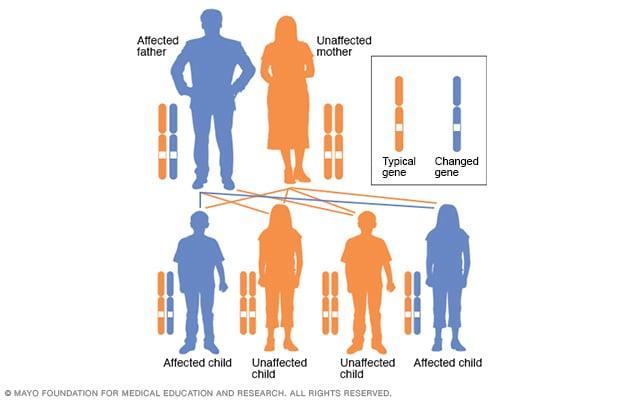
Autosomal dominant inheritance pattern
In an autosomal dominant disorder, the changed gene is a dominant gene. It's located on one of the nonsex chromosomes, called autosomes. Only one changed gene is needed to be affected by this type of condition. A person with an autosomal dominant condition — in this example, the father — has a 50 percent chance of having an affected child with one changed gene. The person has a 50 percent chance of having an unaffected child.
Huntington's disease is caused by a difference in a single gene that's passed down from a parent. Huntington's disease follows an autosomal dominant inheritance pattern. This means that a person needs only one copy of the nontypical gene to develop the disorder.
With the exception of genes on the sex chromosomes, a person inherits two copies of every gene — one copy from each parent. A parent with a nontypical gene could pass along the nontypical copy of the gene or the healthy copy. Each child in the family, therefore, has a 50 percent chance of inheriting the gene that causes the genetic condition.
Risk factors
People who have a parent with Huntington's disease are at risk of having the disease themselves. Children of a parent with Huntington's have a 50 percent chance of having the gene change that causes Huntington's.
Complications
After Huntington's disease starts, a person's ability to function gradually gets worse over time. How quickly the disease gets worse and how long it takes varies. The time from the first symptoms to death is often about 10 to 30 years. Juvenile Huntington's disease usually results in death within 10 to 15 years after symptoms develop.
The depression linked with Huntington's disease may increase the risk of suicide. Some research suggests that risk of suicide is greater before a diagnosis and also when a person loses independence.
Eventually, a person with Huntington's disease requires help with all activities of daily living and care. Late in the disease, the person will likely be confined to a bed and unable to speak. Someone with Huntington's disease is generally able to understand language and has an awareness of family and friends, though some won't recognize family members.
Common causes of death include:
- Pneumonia or other infections.
- Injuries related to falls.
- Complications related to trouble swallowing.
Prevention
People with a known family history of Huntington's disease may be concerned about whether they may pass the Huntington gene on to their children. They might consider genetic testing and family planning options.
If an at-risk parent is considering genetic testing, it can be helpful to meet with a genetic counselor. A genetic counselor explains the potential risks of a positive test result, which may mean that the parent may develop the disease. Also, couples may need to make additional choices about whether to have children or to consider alternatives. They may decide to choose prenatal testing for the gene or in vitro fertilization with donor sperm or eggs.
Another option for couples is in vitro fertilization and preimplantation genetic diagnosis. In this process, eggs are removed from the ovaries and fertilized with the father's sperm in a laboratory. The embryos are tested for the presence of the Huntington gene. Only those testing negative for the Huntington gene are implanted in the mother's uterus.
In vitro fertilization
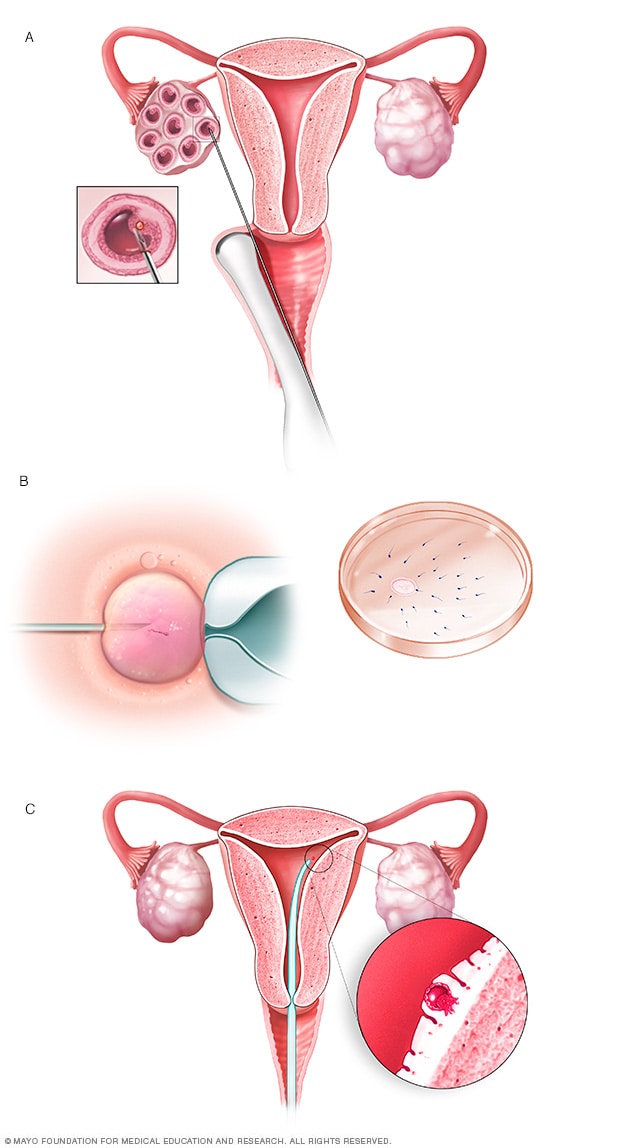
In vitro fertilization
During in vitro fertilization, eggs are removed from sacs called follicles within an ovary (A). An egg is fertilized by injecting a single sperm into the egg or mixing the egg with sperm in a petri dish (B). The fertilized egg, called an embryo, is transferred into the uterus (C).