Overview
Area commonly affected by ischemic colitis
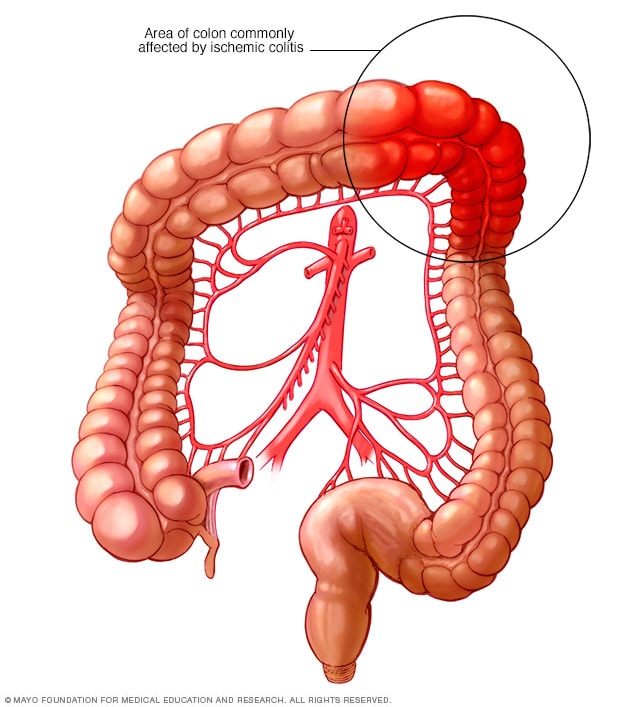
Area commonly affected by ischemic colitis
Ischemic colitis occurs when blood flow to part of the large intestine is reduced. The condition can affect any part of the colon but is most common in the upper left segment.
Ischemic colitis occurs when blood flow to part of the large intestine is temporarily reduced. This segment of the large intestine is called the colon. This reduced blood flow may be caused by narrowing of the blood vessels supplying the colon. It also may be due to reduced blood flow caused by low blood pressure. The diminished blood flow doesn't provide enough oxygen for the cells in the digestive system. This can result in tissue damage to the affected area of the intestine.
Any part of the colon can be affected, but ischemic colitis most commonly causes pain on the left side of the belly area.
Ischemic colitis can be misdiagnosed because it can easily be confused with other digestive problems. You may need medicine to treat ischemic colitis or prevent infection. Or you may need surgery if your colon has been damaged. Most often, however, ischemic colitis heals on its own.
Symptoms
Symptoms of ischemic colitis can include:
- Pain, tenderness or cramping in your belly, which can occur suddenly or happen over time
- Bright red or maroon blood in your stool or, at times, passage of blood alone without stool
- A feeling of urgency to move your bowels
- Diarrhea
- Nausea
The risk of severe complications is higher when you have symptoms on the right side of your belly. This is less commonly seen compared with left-sided colitis. People with right-sided colitis tend to have more underlying medical problems, such as high blood pressure, atrial fibrillation and kidney disease. They more frequently have to undergo surgery and also have a higher risk of death.
When to see a doctor
Seek immediate medical care if you have sudden, severe pain in your belly area. Pain that makes you so uncomfortable that you can't sit still or find a comfortable position is a medical emergency.
Contact your health care provider if you develop worrisome symptoms, such as bloody diarrhea. Early diagnosis and treatment can help prevent serious complications.
Causes
The precise cause of diminished blood flow to the colon isn't always clear. But several factors can increase your risk of ischemic colitis:
- Buildup of fatty deposits on the walls of an artery, also called atherosclerosis
- Low blood pressure, also called hypotension, associated with dehydration, heart failure, surgery, trauma or shock
- Bowel obstruction caused by a hernia, scar tissue or a tumor
- Surgery involving the heart or blood vessels, or the digestive or gynecological systems
- Other medical disorders that affect your blood, such as inflammation of the blood vessels, called vasculitis, lupus or sickle cell anemia
- Cocaine or methamphetamine use
- Colon cancer, which is rare
The role of medications
The use of certain medicines also can lead to ischemic colitis, though this is rare. These include:
- Some heart and migraine medicines
- Hormone medicines, such as estrogen
- Antibiotics
- Pseudoephedrine
- Opioids
- Certain medicines for irritable bowel syndrome
- Chemotherapy medicines
Risk factors
Risk factors for ischemic colitis include:
- Age. The condition occurs mostly frequently in adults older than age 60. Ischemic colitis that occurs in a young adult may be a sign of a blood-clotting irregularity. Or it also may be due to inflammation of the blood vessels, also known as vasculitis.
- Sex. Ischemic colitis is more common in women.
- Clotting problems. Conditions that affect the way the blood clots, such as factor V Leiden, may increase the risk of ischemic colitis.
- High cholesterol, which can lead to atherosclerosis.
- Reduced blood flow, due to heart failure, low blood pressure or shock. It may also be caused by certain conditions, such as diabetes or rheumatoid arthritis.
- Previous abdominal surgery. Scar tissue that forms after surgery may cause reduced blood flow.
- Heavy exercise, such as marathon running, which can lead to reduced blood flow to the colon.
- Surgery involving the large artery that pumps blood from your heart to the rest of your body. This artery is called the aorta.
Complications
Ischemic colitis usually gets better on its own within 2 to 3 days. In more-severe cases, complications can include:
- Tissue death, also called gangrene, resulting from diminished blood flow
- Hole formation, also known as perforation, in the intestine or persistent bleeding
- Bowel obstruction, also called ischemic stricture
Prevention
Since the cause of ischemic colitis isn't always clear, there's no certain way to prevent the disorder. Most people who have ischemic colitis recover quickly and may never have another episode.
To prevent recurrent episodes of ischemic colitis, some doctors recommend stopping any medicine that might cause the condition. Making sure to stay adequately hydrated, especially when doing vigorous outdoor activities, is also important — especially for those living in warm climates. A test for clotting problems may be recommended as well, especially if no other cause for ischemic colitis is apparent.
Oct. 22, 2022