Overview
Laser resurfacing is a facial rejuvenation procedure that uses a laser to improve the skin's appearance or treat minor facial flaws. It can be done with:
- Ablative laser. This type of laser removes the thin outer layer of skin (epidermis) and heats the underlying skin (dermis), which stimulates the growth of collagen — a protein that improves skin firmness and texture. As the epidermis heals and regrows, the treated area appears smoother and tighter. Types of ablative therapy include a carbon dioxide (CO2) laser, an erbium laser and combination systems.
- Nonablative laser or light source. This approach also stimulates collagen growth. It's a less aggressive approach than an ablative laser and has a shorter recovery time. But the results are less noticeable. Types include pulsed-dye laser, erbium (Er:YAG) and intense pulsed light (IPL) therapy.
Both methods can be delivered with a fractional laser, which leaves microscopic columns of untreated tissue throughout the treatment area. Fractional lasers were developed to shorten recovery time and reduce the risk of side effects.
Laser resurfacing can lessen the appearance of fine lines in the face. It can also treat loss of skin tone and improve your complexion. Laser resurfacing can't eliminate excessive or sagging skin.
Products & Services
Why it's done
Laser resurfacing can be used to treat:
- Fine wrinkles
- Age spots
- Uneven skin tone or texture
- Sun-damaged skin
- Mild to moderate acne scars
Risks
Laser resurfacing can cause side effects. Side effects are milder and less likely with nonablative approaches than with ablative laser resurfacing.
- Redness, swelling, itching and pain. Treated skin may swell, itch or have a burning sensation. Redness may be intense and might last for several months.
- Acne. Applying thick creams and bandages to your face after treatment can worsen acne or cause you to temporarily develop tiny white bumps (milia) on treated skin.
- Infection. Laser resurfacing can lead to a bacterial, viral or fungal infection. The most common infection is a flare-up of the herpes virus — the virus that causes cold sores. In most cases, the herpes virus is already present but dormant in the skin.
- Changes in skin color. Laser resurfacing can cause treated skin to become darker than it was before treatment (hyperpigmentation) or lighter (hypopigmentation). Permanent changes in skin color are more common in people with dark brown or Black skin. Talk with your doctor about which laser resurfacing technique reduces this risk.
- Scarring. Ablative laser resurfacing poses a slight risk of scarring.
Laser resurfacing isn't for everyone. Your doctor might caution against laser resurfacing if you:
- Have taken the acne medication isotretinoin (Amnesteem) during the past year
- Have a connective tissue or autoimmune disease or a weak immune system
- Have a history of keloid scars
- Have had radiation therapy to the face
- Have a history of previous laser resurfacing
- Are prone to cold sores or have had a recent outbreak of cold sores or herpes virus
- Have darker brown or Black skin or are very tanned
- Are pregnant or breastfeeding
- Have a history of an outward-turning eyelid (ectropion)
How you prepare
Before you have laser resurfacing, your doctor will likely:
- Ask about your medical history. Be prepared to answer questions about current and past medical conditions and any medications you are taking or have taken recently. Your doctor might also ask about previous cosmetic procedures you've had and how you react to sun exposure — for example, do you burn easily? rarely?
- Do a physical exam. Your doctor will inspect your skin and the area that will be treated. This helps determine what changes can be made and how your physical features — for example, the tone and thickness of your skin — might affect your results.
- Discuss your expectations. Talk with your doctor about your motivations, expectations and the potential risks. Together, you can decide whether laser resurfacing is right for you and, if so, which approach to use. Make sure you understand how long it'll take to heal and what your results might be.
Before laser resurfacing, you might also need to:
- Take medication to prevent complications. If you're having ablative laser resurfacing — or nonablative laser resurfacing and you have a history of herpes infections around your mouth — your doctor will prescribe an antiviral medication before and after treatment to prevent a viral infection. Depending on your medical history, your doctor might recommend other medications before your procedure.
- Avoid unprotected sun exposure. Too much sun up to two months before the procedure can cause permanent irregular pigmentation in treated areas. Discuss sun protection and acceptable sun exposure with your doctor.
- Stop smoking. If you smoke, try to stop at least two weeks before and after your treatment. This improves your chance of avoiding complications and helps your body heal.
- Arrange for a ride home. If you're going to be sedated during laser resurfacing, you'll need help getting home after the procedure.
What you can expect
During the procedure
How laser resurfacing is done
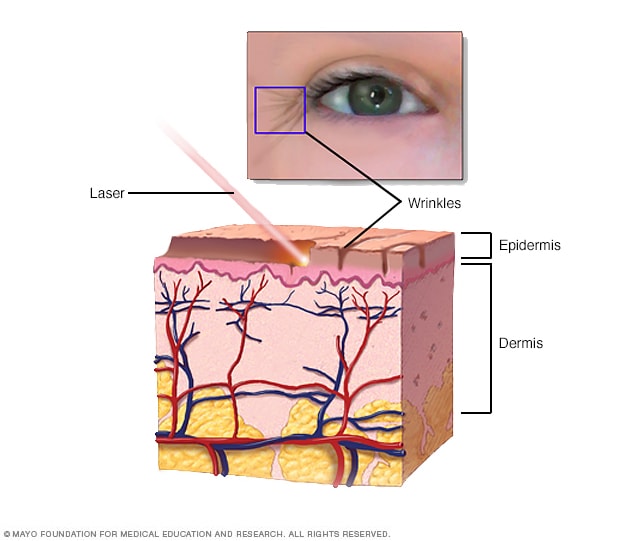
How laser resurfacing is done
During ablative laser resurfacing, a laser destroys the outer layer of skin (epidermis). As the wound heals, new skin forms that's smoother and tighter.
Your doctor may do laser resurfacing as an outpatient procedure. Your care team will numb skin with medication. For extensive resurfacing, such as treatment to your whole face, you might be sedated.
During ablative laser resurfacing, an intense beam of light energy (laser) is directed at your skin. The laser beam destroys the outer layer of skin (epidermis). At the same time, the laser heats the underlying skin (dermis), which stimulates collagen production over time, resulting in better skin tone and texture. Ablative laser resurfacing typically takes between 30 minutes and two hours, depending on the technique used and the size of the area treated. This approach usually needs only one treatment.
If you're undergoing nonablative laser treatment or fractional Er:YAG laser resurfacing, you'll likely need 1 to 3 treatments scheduled over weeks or months to get the results you're looking for.
After the procedure
After ablative laser resurfacing, the treated skin will be raw, swollen and itchy. Your doctor will apply a thick ointment to the treated skin and might cover the area with an airtight and watertight dressing. You may take a pain reliever and use ice packs. New skin usually covers the area in one or two weeks and full recovery takes at least a month. During this time do not use products that may irritate your face, such as cosmetics. And avoid situations that increase your risk of infection, such as public whirlpools. Always use sun protection following laser resurfacing.
After nonablative laser resurfacing, recovery time is minimal. Your skin might be swollen or inflamed for a few hours. Use ice packs as needed. Typically, you can resume your usual activities and skin routine immediately.
Results
After ablative laser resurfacing, your skin might stay inflamed for up to several months. But once the treatment area begins to heal, you'll notice a difference in your skin quality and appearance. The effects can last for years.
Results after nonablative laser resurfacing tend to be gradual and progressive. You're more likely to notice improvements in skin texture and pigment than in wrinkles.
After laser resurfacing, always use sun protection. As you age, you'll continue to get lines by squinting and smiling. New sun damage also can reverse your results. Every day, use a moisturizer and a sunscreen with an SPF of at least 30.