Overview
LASIK surgery
LASIK surgery
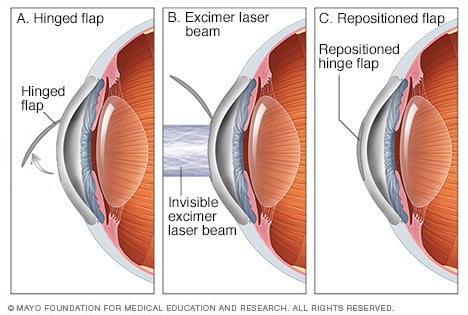
During LASIK eye surgery, an eye surgeon creates a flap in the cornea — the transparent, dome-shaped surface of the eye that accounts for a large part of the eye's bending or refracting power (A). Then the surgeon uses a laser to reshape the cornea, which corrects the refraction problems in the eye (B). The flap is then put back in place (C).
LASIK eye surgery is the best known and most commonly performed laser refractive surgery to correct vision problems. Laser-assisted in situ keratomileusis (LASIK) can be an alternative to glasses or contact lenses.
During LASIK surgery, a special type of cutting laser is used to change the shape of the cornea. The cornea is the dome-shaped clear tissue at the front of the eye.
In eyes with typical vision, the cornea bends — or refracts — light precisely onto the retina at the back of the eye. But with nearsightedness, farsightedness or astigmatism, the light is bent incorrectly. This incorrect refraction causes blurred vision.
Glasses or contact lenses can correct vision, but reshaping the cornea also provides the refraction needed to correct vision.
Why it's done
Anatomy of the eye

Anatomy of the eye
Your eye is a complex and compact structure measuring about 1 inch (2.5 centimeters) in diameter. It receives millions of pieces of information about the outside world, which are quickly processed by your brain.
Nearsightedness (myopia)
Nearsightedness (myopia)
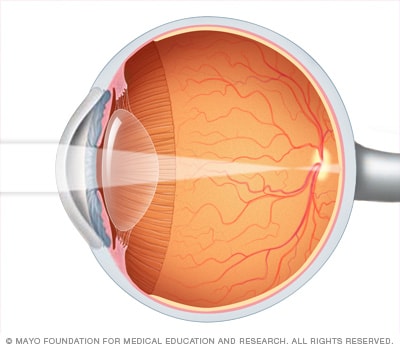
With typical vision, an image is sharply focused onto the surface of the retina. In nearsightedness, the point of focus is in front of the retina, making distant objects appear blurry.
Farsightedness (hyperopia)
Farsightedness (hyperopia)
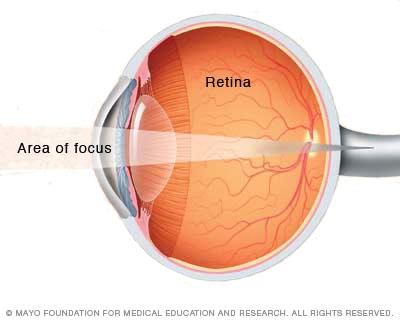
With typical vision, an image is sharply focused onto the surface of the retina. In farsightedness, the point of focus falls behind the retina, making close-up objects appear blurry.
LASIK surgery may be an option for the correction of these vision problems:
- Nearsightedness, also called myopia. In nearsightedness, your eyeball is slightly longer than typical or the cornea curves too sharply. This causes light rays to focus in front of the retina, which makes distant vision blurry. Objects that are close can be seen fairly clearly. But objects in the distance will be blurry.
- Farsightedness, also called hyperopia. In farsightedness, you have a shorter than average eyeball or a cornea that is too flat. This causes light to focus behind the retina instead of on it. This makes near vision, and sometimes distant vision, blurry.
- Astigmatism. In astigmatism, the cornea curves or flattens unevenly. This affects focus of near and distant vision.
If you're considering LASIK surgery, you probably already wear glasses or contact lenses. Your eye doctor will talk with you about whether LASIK surgery or another similar refractive procedure is an option that will work for you.
Risks
Complications that result in a loss of vision are very rare. But certain side effects of LASIK eye surgery are common. These include dry eyes and temporary visual problems such as glare. These symptoms usually clear up after a few weeks or months. Few people consider them to be a long-term problem.
Risks of LASIK surgery include:
-
Dry eyes. LASIK surgery causes a temporary decrease in tear production. For the first six months or so after your surgery, your eyes may feel unusually dry as they heal. Dry eyes can reduce the quality of your vision.
Your eye doctor might recommend eye drops for dry eyes. If you experience severe dry eyes, your eye doctor may recommend additional management, including tear drain plugs or medicated eye drops.
-
Glare, halos and double vision. You may have a hard time seeing at night after surgery. This usually lasts a few days to a few weeks. You might notice increased light sensitivity, glare, halos around bright lights or double vision.
Even when a good visual result is measured under standard testing conditions, your vision in dim light (such as at dusk or in fog) may be reduced to a greater degree after the surgery than before the surgery.
- Undercorrections. If the laser removes too little tissue from your eye, you won't get the clearer vision results you were hoping for. Undercorrections are more common for people who are nearsighted. You may need another LASIK procedure within a year to remove more tissue.
- Overcorrections. It's also possible that the laser will remove too much tissue from your eye. Overcorrections may be more difficult to fix than undercorrections.
- Astigmatism. Astigmatism can be caused by uneven tissue removal. It may require another surgery, glasses or contact lenses.
- Flap problems. Folding back or removing the flap from the front of your eye during surgery can cause complications, including infection and excess tears. The outermost corneal tissue layer may grow abnormally underneath the flap during the healing process.
- Corneal ectasia. Corneal ectasia, a condition in which the cornea is too thin and weak, is one of the more-serious complications. The abnormal cornea tissue is unable to maintain its shape, which can lead to cornea bulging and worsening vision.
- Regression. Regression is when your vision slowly changes back toward your original prescription. This is a less common complication.
- Vision loss or changes. Rarely, surgical complications can result in loss of vision. Some people also may not see as sharply or clearly as previously.
Conditions that increase risks
Certain health conditions can increase the risks associated with LASIK surgery or make the outcome less predictable.
Doctors may not recommend laser refractive surgery for you if you have certain conditions, including:
- Autoimmune disorders, such as rheumatoid arthritis.
- A weakened immune system caused by immunosuppressive medications or HIV.
- Constantly dry eyes.
- Recent changes in vision due to medicines, hormonal changes, pregnancy, breastfeeding or age.
- Inflammation of the cornea, lid disorders, eye injuries or eye diseases, such as uveitis, herpes simplex affecting the eye area, glaucoma or cataracts.
- Disorders of the cornea, including keratoconus or corneal ectasia.
LASIK surgery is usually not recommended if you:
- Have an eye disease that causes the cornea to thin and bulge, such as keratoconus.
- Have a family history of keratoconus or other corneal ectasia.
- Have good overall vision.
- Have severe nearsightedness.
- Have very large pupils or thin corneas.
- Have age-related eye changes that cause vision to be less clear.
- Participate in contact sports that may be associated with blows to the face.
If you're considering LASIK surgery, talk to your doctor about your questions and concerns. Your doctor will discuss whether you're a candidate for the procedure or other similar procedures.
How you prepare
Steps you can take to prepare for surgery include:
- Know what surgery may cost you. LASIK surgery is usually considered elective surgery, so most insurance companies won't cover the cost of the surgery. Be prepared to pay out-of-pocket for your expenses.
- Arrange for a ride home. You'll need to have someone drive you to and from your place of surgery. Immediately after surgery, you might still feel the effects of medicine given to you before surgery, and your vision may be blurry.
- Skip the eye makeup. Don't use eye makeup, cream, perfumes or lotions on the day before and the day of your surgery. Your doctor may also tell you to clean your eyelashes daily or more often in the days leading up to surgery. This helps remove debris and lessens your risk of infection.
What you can expect
Before the procedure
Long-term results from LASIK tend to be best in people who are carefully checked before surgery to see if they are good candidates for the procedure.
If you wear contact lenses, you'll need to stop wearing them and wear only your glasses for at least a few weeks before your evaluation and surgery. This is because contact lenses can change the shape of your cornea. Your eye doctor will provide specific guidelines depending on the type of contacts you wear and how long you've been a contact lens wearer.
During the evaluation, your eye doctor will ask about your medical and surgical history and give you a complete eye examination to check your vision and decide whether you can undergo the procedure safely.
Your eye doctor will look for signs of:
- Eye infection.
- Inflammation.
- Dry eyes.
- Large pupils.
- High eye pressure.
Your eye doctor will also measure your cornea, noting the shape, contour, thickness and any irregularities. Your eye doctor will check which areas of your cornea need reshaping and determine the exact amount of tissue to remove from your cornea.
Doctors generally use wavefront-guided technology to check your eye in detail before LASIK surgery. In this test, a scanner creates a highly detailed chart, similar to a topographic map, of your eye. The more detailed the measurements, the more accurate your eye doctor can be in removing corneal tissue.
Before surgery, your doctor will discuss the risks and benefits of LASIK surgery, what to expect before and after surgery, and any questions you may have.
During the procedure
LASIK surgery is usually completed in 30 minutes or less. During the procedure, you lie on your back in a reclining chair. You may be given medicine to help you relax. After numbing drops are placed in your eye, your doctor uses an instrument to hold your eyelids open.
A suction ring is placed on your eye just before cutting the corneal flap. This may cause a feeling of pressure, and your vision may dim a little.
Your eye surgeon uses a small blade or cutting laser to cut a small hinged flap away from the front of your eye. Folding back the flap allows your doctor to reach the part of your cornea to be reshaped.
Using a programmed laser, your eye surgeon reshapes parts of your cornea. With each pulse of the laser beam, a tiny amount of corneal tissue is removed. After reshaping the cornea, the surgeon lays the flap back into place. The flap usually heals without stitches.
During the surgery, you'll be asked to focus on a point of light. Staring at this light helps you keep your eye fixed while the laser reshapes your cornea. You may notice a distinct odor as the laser removes your corneal tissue. Some people describe smelling an odor similar to that of burning hair.
If you need LASIK surgery in both eyes, doctors will generally do the procedure on the same day.
LASIK surgery is performed with a laser programmed to remove a defined amount of tissue from a part of your eye called the cornea.
To begin, your doctor uses a special blade — or laser — to cut a flap on the top layer of your cornea, about the size of a contact lens. The flap allows access to the deeper layers of your eye.
The laser is used again to flatten certain tissue or to make the tissue steeper, depending on your needs for corrected vision. Finally, the flap is folded back into place and will heal on its own.
After the procedure
Immediately after surgery, your eye might itch, feel gritty, burn and be watery. You'll probably have blurred vision. You generally will experience little pain, and you'll usually recover your vision quickly.
You might be given pain medicine or eye drops to keep you comfortable for several hours after the procedure. Your eye doctor might also ask you to wear a shield over your eye at night until your eye heals.
You'll be able to see after surgery, but your vision won't be clear right away. While vision after LASIK is generally good within a few days, it can be up to 2 to 3 months after your surgery before your eye heals completely and your vision stabilizes. Your chances for improved vision are based, in part, on how good your vision was before surgery.
You'll have a follow-up appointment with your eye doctor 1 to 2 days after surgery. This is to see how your eye is healing and check for any complications. Plan for other follow-up appointments during the first six months after surgery as your doctor recommends.
It might be a few weeks before you can start to use cosmetics around your eyes again. You also might have to wait several weeks before resuming strenuous contact sports, swimming or using hot tubs.
Follow your doctor's recommendations about how soon you can resume your usual activities.
Results
LASIK often offers improved vision without the hassle of glasses or contact lenses. In general, you have a very good chance of achieving 20/40 vision or better after refractive surgery.
More than 8 out of 10 people who've undergone LASIK refractive surgery no longer need to use their glasses or contact lenses for most of their activities.
Your results depend on your specific refractive error and other factors. People with a low grade of nearsightedness tend to have the most success with refractive surgery. People with a high degree of nearsightedness or farsightedness along with astigmatism have less predictable results.
In some cases, the surgery might result in undercorrection. If this happens, you might need another surgery to achieve the proper correction.
Rarely, some people's eyes slowly return to the level of vision they had before surgery. This might happen due to certain conditions, such as problems with wound healing, hormonal imbalances or pregnancy. Sometimes this change in vision is due to another eye problem, such as a cataract. Talk with your doctor about any vision changes.
Aug. 02, 2023