Overview
Merkel cell carcinoma
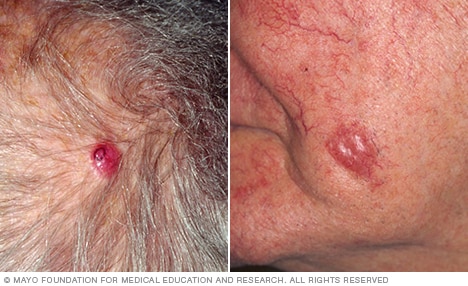
Merkel cell carcinoma
Merkel cell carcinoma is a rare, aggressive skin cancer. It appears as a painless, flesh-colored or bluish-red nodule growing on your skin.
Merkel cell carcinoma is a rare type of skin cancer that usually appears as a flesh-colored or bluish-red nodule, often on your face, head or neck. Merkel cell carcinoma is also called neuroendocrine carcinoma of the skin.
Merkel cell carcinoma most often develops in older people. Long-term sun exposure or a weak immune system may increase your risk of developing Merkel cell carcinoma.
Merkel cell carcinoma tends to grow fast and to spread quickly to other parts of your body. Treatment options for Merkel cell carcinoma often depend on whether the cancer has spread beyond the skin.
Products & Services
Symptoms
The first sign of Merkel cell carcinoma is usually a fast-growing, painless nodule (tumor) on your skin. The nodule may be skin-colored or may appear in shades of red, blue or purple. Most Merkel cell carcinomas appear on the face, head or neck, but they can develop anywhere on your body, even on areas not exposed to sunlight.
When to see a doctor
If you notice a mole, freckle or bump that is changing in size, shape or color, growing rapidly, or bleeding easily after minor trauma, such as washing your skin or shaving, make an appointment with your doctor.
Causes
It's not clear what causes Merkel cell carcinoma. Merkel cell carcinoma begins in the Merkel cells. Merkel cells are found at the base of the outermost layer of your skin (epidermis). Merkel cells are connected to the nerve endings in the skin that are responsible for the sense of touch.
Researchers recently discovered that a common virus plays a role in causing most cases of Merkel cell carcinoma. The virus (Merkel cell polyomavirus) lives on the skin and doesn't cause any signs or symptoms. Just how this virus causes Merkel cell carcinoma has yet to be determined. Given that the virus is very common and Merkel cell carcinoma is very rare, it's likely that other risk factors play a role in the development of this cancer.
Risk factors
Factors that may increase your risk of Merkel cell carcinoma include:
- Excessive exposure to natural or artificial sunlight. Being exposed to ultraviolet light, such as the light that comes from the sun or from tanning beds, increases your risk of Merkel cell carcinoma. The majority of Merkel cell carcinomas appear on skin surfaces frequently exposed to sun.
- A weakened immune system. People with weakened immune systems — including those with HIV infection, those taking drugs that suppress the immune response or those with chronic leukemias — are more likely to develop Merkel cell carcinoma.
- History of other skin cancers. Merkel cell carcinoma is associated with the development of other skin cancers, such as basal cell or squamous cell carcinoma.
- Older age. Your risk of Merkel cell carcinoma increases as you age. This cancer is most common in people older than age 50, though it can occur at any age.
- Light skin color. Merkel cell carcinoma usually arises in people who have light-colored skin. Whites are much more likely to be affected by this skin cancer than are blacks.
Complications
Cancer that spreads to other parts of the body
Even with treatment, Merkel cell carcinoma commonly spreads (metastasizes) beyond the skin. Merkel cell carcinoma tends to travel first to nearby lymph nodes. Later it may spread to your brain, bones, liver or lungs, where it can interfere with the functioning of these organs. Cancer that has metastasized is more difficult to treat and can be fatal.
Prevention
While exposure to sunlight isn't proved to cause Merkel cell carcinoma, it is considered a risk factor for this cancer. Reducing your sun exposure may reduce your risk of skin cancer. Try to:
- Avoid the sun during peak hours. Avoid sun exposure as much as possible during the strongest sunlight hours of the day — typically from 10 a.m. to 4 p.m. Move your outdoor activities to a time earlier in the morning or later in the day.
- Shield your skin and eyes. Wear a wide-brimmed hat, tightly woven clothing and sunglasses with ultraviolet (UV) light protection.
- Apply sunscreen liberally and often. Use a broad-spectrum sunscreen with an SPF of at least 30, even on cloudy days. Apply sunscreen generously, and reapply every two hours — or more often if you're swimming or perspiring.
- Watch for changes. If you notice a mole, freckle or bump that's changing in size, shape or color, talk to your doctor. Most skin nodules never become cancer, but catching cancer in its early stages increases the chances that treatment will be successful.
Dec. 06, 2022