Overview
Mild cognitive impairment (MCI) is the stage between the expected decline in memory and thinking that happens with age and the more serious decline of dementia. MCI may include problems with memory, language or judgment.
People with MCI may be aware that their memory or mental function has "slipped." Family and close friends also may notice changes. But these changes aren't bad enough to impact daily life or affect usual activities.
MCI may increase the risk of dementia caused by Alzheimer's disease or other brain disorders. But some people with mild cognitive impairment might never get worse. And some eventually get better.
Products & Services
Symptoms
The brain, like the rest of the body, changes with age. Many people notice they become more forgetful as they age. It may take longer to think of a word or to recall a person's name.
If concerns with mental function go beyond what's expected, the symptoms may be due to mild cognitive impairment (MCI). MCI may be the cause of changes in thinking if:
- You forget things more often.
- You miss appointments or social events.
- You lose your train of thought. Or you can't follow the plot of a book or movie.
- You have trouble following a conversation.
- You find it hard to make decisions, finish a task or follow instructions.
- You start to have trouble finding your way around places you know well.
- You begin to have poor judgment.
- Your family and friends notice any of these changes.
If you have MCI, you also may experience:
- Depression.
- Anxiety.
- A short temper and aggression.
- A lack of interest.
When to see a doctor
Talk to your health care provider if you or someone close to you notices you're having problems with memory or thinking. This may include trouble recalling recent events or having trouble thinking clearly.
Causes
Changes in brain structure with MCI and Alzheimer's disease
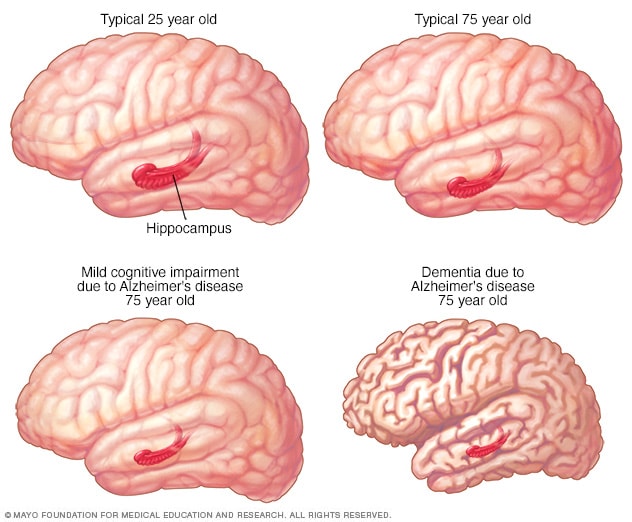
Changes in brain structure with MCI and Alzheimer's disease
Some changes in brain structure — such as the decrease in size of the brain's memory center (hippocampus) — are typical with aging. However, this reduction in size is greater in those with mild cognitive impairment and even more dramatic in people with Alzheimer's disease.
Brain shrinkage in MCI and Alzheimer's disease
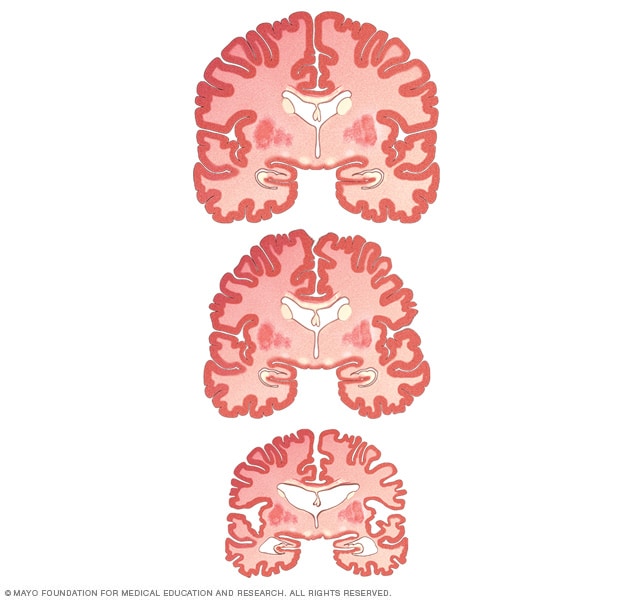
Brain shrinkage in MCI and Alzheimer's disease
Dementia causes the brain to lose mass, especially in critical areas. Note the difference in size between a healthy brain (top), a mild cognitive impairment brain (middle) and an Alzheimer's disease brain (bottom).
There's no single cause of mild cognitive impairment (MCI), although MCI may be due to early Alzheimer's disease. There's no single outcome for the disorder. Symptoms of MCI may remain stable for years. Or MCI may progress to Alzheimer's disease dementia or another type of dementia. In some cases, MCI may improve over time.
MCI often involves the same types of brain changes seen in Alzheimer's disease or other forms of dementia. In MCI, those changes occur at a lesser degree. Some of these changes have been seen in autopsy studies of people with MCI.
These changes include:
- Clumps of beta-amyloid protein, called plaques, and tangles of tau proteins that are seen in Alzheimer's disease.
- Microscopic clumps of a protein called Lewy bodies. These clumps are associated with Parkinson's disease, dementia with Lewy bodies and some cases of Alzheimer's disease.
- Small strokes or reduced blood flow through brain blood vessels.
Brain-imaging studies show that the following changes may be associated with MCI:
- Decreased size of the hippocampus, a brain region important for memory.
- Increased size of the brain's fluid-filled spaces, known as ventricles.
- Reduced use of glucose in key brain regions. Glucose is the sugar that's the main source of energy for cells.
Risk factors
The strongest risk factors for MCI are:
- Increasing age.
- Having a form of a gene known as APOE e4. This gene also is linked to Alzheimer's disease. But having the gene doesn't guarantee that you'll have a decline in thinking and memory.
Other medical conditions and lifestyle factors have been linked to an increased risk of changes in thinking, including:
- Diabetes.
- Smoking.
- High blood pressure.
- High cholesterol.
- Obesity.
- Depression.
- Obstructive sleep apnea.
- Lack of physical exercise.
- Low education level.
- Lack of mentally or socially stimulating activities.
Complications
People with MCI have an increased risk — but not a certainty — of developing dementia. Overall, about 1% to 3% of older adults develop dementia every year. Studies suggest that around 10% to 15% of people with MCI go on to develop dementia each year.
Prevention
Mild cognitive impairment can't be prevented. But research has found some lifestyle factors may lower the risk of getting MCI. Studies show that these steps may help prevent MCI:
- Don't drink large amounts of alcohol.
- Limit exposure to air pollution.
- Reduce your risk of a head injury.
- Don't smoke.
- Manage health conditions such as diabetes, high blood pressure, obesity and depression.
- Practice good sleep hygiene and manage any sleep problems.
- Eat a healthy diet full of nutrients. Include fruits and vegetables and foods low in saturated fats.
- Stay social with friends and family.
- Exercise at a moderate to vigorous intensity most days of the week.
- Wear a hearing aid if you have hearing loss.
- Stimulate your mind with puzzles, games and memory training.
Feb. 13, 2024