Overview
Nearsightedness
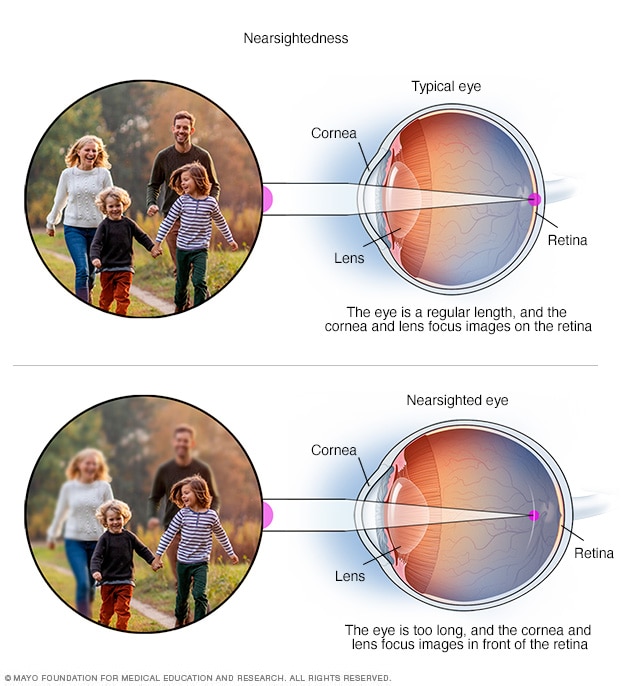
Nearsightedness
With typical vision, an image is sharply focused onto the retina. In nearsightedness, the point of focus is in front of the retina, making distant objects appear blurry.
Nearsightedness is a common vision condition in which close objects look clear but far objects look blurry. The medical term for nearsightedness is myopia. Myopia happens when the shape of the eye — or the shape of certain parts of the eye — causes light rays to bend or refract. Light rays that should be focused on nerve tissues at the back of the eye, called the retina, are focused in front of the retina instead.
Nearsightedness usually develops during childhood and adolescence. Typically, it becomes more stable between the ages of 20 and 40. It tends to run in families.
A basic eye exam can confirm nearsightedness. You can correct the blurry vision with eyeglasses, contact lenses or refractive surgery.
Symptoms
Nearsightedness symptoms may include:
- Blurry vision when looking at distant objects.
- The need to squint or partially close the eyelids to see clearly.
- Headaches.
- Eyestrain.
School-age children may have difficulty seeing things on whiteboards or screen projections in the classroom. Younger children might not express difficulty seeing, but they may have the following behaviors that suggest difficulty seeing:
- Constant squinting.
- Seeming to not be aware of distant objects.
- Blinking often.
- Rubbing the eyes often.
- Sitting close to the television or moving screens closer to the face.
Adults with nearsightedness may notice difficulty reading street signs or signs in stores. Some people may experience blurry vision in dim light, as with nighttime driving, even if they see clearly in daylight. This condition is called night myopia.
When to see a doctor
Make an appointment with an eye care specialist if your child shows any signs of vision problems or if a teacher reports possible problems.
Make an appointment for yourself if you notice a change in your vision, have difficulty performing tasks such as driving or find that the quality of your vision affects your enjoyment of activities.
Seek emergency medical care if you experience any of the following:
- Sudden appearance of many floaters — tiny specks or lines that seem to drift through your field of vision.
- Flashes of light in one or both eyes.
- A curtain-like gray shadow covering all or part of your field of vision.
- A shadow in your outer or side vision, known as peripheral vision.
These are warnings signs of the retina becoming detached from the back of the eye. This condition is a medical emergency requiring prompt treatment. Significant nearsightedness is associated with an increased risk of retinal detachment.
Regular eye exams
Both children and adults may not be aware of problems with vision or changes that happen gradually. The American Academy of Ophthalmology recommends regular vision screenings to ensure timely diagnosis and treatment.
Children and adolescents
Your child's pediatrician or other healthcare professional does relatively simple exams to check the health of your child's eyes at birth, between 6 and 12 months of age, and between 12 and 36 months of age. If there are any problems, you may be referred to a doctor specializing in eye health and care, called an ophthalmologist.
Vision screenings are tests to check for vision problems. A screening test may be done by a pediatrician, an ophthalmologist, an optometrist or another trained provider. Vision screenings are often offered at schools or community centers.
The recommended times for screening are as follows:
- At least once between ages 3 and 5.
- Before kindergarten, usually age 5 or 6.
- Annually through the end of high school.
If a problem is found in a screening test, you'll likely need to schedule a complete eye exam with an optometrist or ophthalmologist.
Adults
The American Academy of Ophthalmology recommends that healthy adults with no known problems with vision or eye disease should get a complete eye exam on the following schedule:
- At least once between ages 20 and 29.
- At least twice between ages 30 and 39.
- Every 2 to 4 years from ages 40 to 54.
- Every 1 to 3 years from ages 55 to 64.
- Every 1 to 2 years after age 65.
If you have diabetes, a family history of eye disease, high blood pressure, or other risks of heart or vascular disease, you'll likely need more-regular eye exams. Also, you'll likely need more-regular exams if you already have prescription glasses or contacts or if you've had surgery for vision correction. Your healthcare professional or eye care specialist can recommend how often to get an exam.
Causes
The eye has two parts that focus images:
- The cornea is the clear, dome-shaped front surface of the eye.
- The lens is a clear structure about the size and shape of a pinto bean.
For you to see, light has to pass through the cornea and lens. These parts of the eye bend — also called refract — the light so that the light is focused directly on the retina at the back of your eye. These tissues translate light into signals sent to the brain, which lets you perceive images.
Refractive errors
Nearsightedness is a refractive error. This problem happens when the shape or condition of the cornea — or the shape of the eye itself — causes an inaccurate focusing of the light passing into the eye.
Nearsightedness usually results when the eye is too long or oval-shaped rather than round. It also may result when the curve of the cornea is too steep. With these changes, light rays come to a point in front of the retina and cross. The messages sent from the retina to the brain are perceived as blurry.
Other refractive errors include:
- Farsightedness, also called hyperopia. In farsightedness, the eyeball is shorter than that in a typical eye or the cornea has too little curve. Some people may see distant objects somewhat clearer, but close objects appear blurry. For some people with farsightedness, objects are blurry at all distances.
- Astigmatism. In astigmatism, the cornea or lens is curved more steeply in one direction than in another. Vision is distorted or blurry at all distances.
Risk factors
Certain risk factors may increase the likelihood of developing nearsightedness, including:
- Genetics. Nearsightedness tends to run in families. If one of your parents is nearsighted, your risk of developing the condition is increased. The risk is higher if both parents are nearsighted.
- Prolonged close-up activities. Reading or doing other close-up activities for a long time is associated with an increased risk of nearsightedness.
- Screen time. Studies have shown that children who use computers or smart devices for long periods have a greater risk of developing nearsightedness.
- Environmental conditions. Some studies support the idea that not spending enough time outdoors may increase the risk of nearsightedness.
Complications
Nearsightedness is associated with a variety of complications, such as:
- Poor school experiences. Children with myopia or other vision problems can experience delays in reading or other academic skills, difficulty with social interactions, and poor self-esteem.
- Reduced quality of life. If nearsightedness isn't corrected, it can prevent you from performing daily tasks well or enjoying activities.
- Eyestrain. Not correcting nearsightedness may cause persistent eyestrain and headaches.
- Impaired safety. Your safety and the safety of others may be jeopardized if you have a vision problem. This could be especially serious if you are driving a car or operating heavy equipment.
- Other eye problems. Severe nearsightedness puts you at an increased risk of retinal detachment, glaucoma, cataracts and other serious eye conditions.