Overview
Noonan syndrome is a genetic condition that stops typical development in various parts of the body. It can affect a person in several ways, including unusual facial features, short height, heart problems and other physical problems. It also can cause a child to develop more slowly than usual, for example, in walking, talking or learning new things.
A changed gene causes Noonan syndrome. A child inherits a copy of an affected gene from a parent. This is called dominant inheritance. The condition also can occur as a spontaneous change. This means there's no family history involved.
Doctors manage Noonan syndrome by controlling the symptoms and complications. They may use a growth hormone to treat short height in some people with Noonan syndrome.
Symptoms
Symptoms of Noonan syndrome vary greatly and range from mild to severe. These symptoms may be related to the specific gene containing the change.
Facial features
How the face looks is one key feature that leads to a diagnosis of Noonan syndrome. Facial features may be easier to see in infants and young children but change with age. These distinct features become less clear in adults.
Noonan syndrome may include these features:
- Eyes are wide-set, slant down and have droopy lids. Eyes may be pale blue or green.
- Ears are set low and look like they're tipped backward.
- Nose is depressed at the top, with a wide base and round tip.
- Mouth has a deep groove between the nose and the mouth and wide peaks in the upper lip. The crease that runs from the edge of the nose to the corner of the mouth becomes deeply grooved with age. Teeth may be crooked. The inside roof of the mouth may be highly arched. And the lower jaw may be small.
- Facial features may appear coarse but look sharper with age. The face may appear droopy and not show expression.
- Head may be large with a big forehead and a low hairline on the back of the head.
- Skin may appear thin and transparent with age.
Heart disease
Many people with Noonan syndrome are born with a heart problem that causes some of the key symptoms of the condition. This is called congenital heart disease. Also, some heart problems can occur later in life.
Some forms of congenital heart disease related to Noonan syndrome include:
- Valve conditions. Pulmonary valve stenosis is a narrowing of the pulmonary valve. This valve is the flap of tissue that separates the lower right chamber of the heart — called the right ventricle — from the artery that supplies blood to the lungs — called the pulmonary artery. Pulmonary valve stenosis is the most common heart problem seen with Noonan syndrome. It may occur with or without other heart problems.
- Thickening of the heart muscle. Unusual growth or thickening of the heart muscle — also known as hypertrophic cardiomyopathy — affects some people with Noonan syndrome.
- Other heart problems. Problems with heart structure can involve a hole in the wall that separates the two lower chambers of the heart, known as ventricles. This is called a ventricular septal defect. Another defect sometimes seen is narrowing of the artery that carries blood to the lungs for oxygen. This is called pulmonary artery stenosis. Or there can be narrowing of the major blood vessel known as the aorta, which carries blood from the heart to the body. This is called aortic coarctation.
- Irregular heart rhythm. This can occur with or without other problems in heart structure. Most people with Noonan syndrome have a heart rhythm that is not regular.
Growth issues
Noonan syndrome can affect typical growth. Many children with Noonan syndrome do not grow at a typical rate.
Issues may include:
- Typical birth weight but slower growth over time.
- Eating difficulties that may lead to poor nutrition and weight gain.
- Growth hormone levels that may be too low.
- Delay in the growth spurt that's typically seen during the teenage years because bones do not reach maximum strength or density until later.
- Short height as an adult, which is common, but some people with Noonan syndrome may not be short.
Issues with muscles and bones
Some common issues can include:
- A condition called pectus excavatum, where the breastbone and ribs sink too far into the chest. It also is possible to have pectus carinatum, where the breastbone and ribs grow outward, making the chest stick out more than usual.
- Nipples that are wide apart.
- Short neck, often with extra folds of skin, called a webbed neck.
- A spine that has an unusual curve.
Learning disabilities
Noonan syndrome does not affect the intelligence of most people who have the condition. But they may have:
- A higher risk of learning disabilities and mild intellectual disability.
- A wide range of mental, emotional and behavioral issues that are usually mild.
- Hearing and vision problems that may make it harder to learn.
Eye conditions
Common signs of Noonan syndrome are eyes and eyelids that are unusual, including:
- Problems with the eye muscles, such as cross-eye, also known as strabismus.
- Refractive problems, which means the cornea or the lens is egg-shaped with two curves that do not match. This can make vision blurry or distorted, or make it hard to see things close up or far away.
- Rapid movement of the eyeballs, also known as nystagmus.
- Cataracts, which make an eye cloudy.
Hearing problems
Noonan syndrome can cause hearing problems due to nerve issues or an inner ear bone structure that is not typical.
Bleeding problems
Noonan syndrome can cause bleeding problems and easy bruising. That's because the blood of some people with Noonan syndrome may not clot properly and may have low levels of proteins that are needed for clots to form. So they bleed longer than usual.
Lymphatic conditions
Noonan syndrome can cause problems with the lymphatic system, which drains excess fluid from the body and helps fight infection. These problems:
- May show up before or after birth or start in the teenage years or as an adult. Some children are born with swelling of the hands, feet and tissue of the neck.
- Can focus on a particular area of the body or be widespread.
- Most commonly cause too much fluid to build up in the back of the hands or top of the feet. This fluid buildup is called lymphedema.
Genital and kidney conditions
Many people with Noonan syndrome have problems with their genitals and kidneys:
- Testicles. It's common for males with Noonan syndrome to have undescended testicles. These are testicles that have not moved into proper position in the bag of skin hanging below the penis, called the scrotum.
- Puberty. Puberty may be delayed in males and females.
- Fertility. For most females, Noonan syndrome does not affect their ability to get pregnant. But fertility in males may not develop as expected, often because of undescended testicles.
- Kidneys. Kidney problems generally are mild and not common.
Skin conditions
People with Noonan syndrome may have skin conditions. They may have various problems that affect the color and texture of the skin. They also may have coarse or sparse hair.
When to see a doctor
Sometimes the symptoms of Noonan syndrome can be hard to see. If you suspect you or your child may have this condition, see your primary care professional or your child's pediatrician. You may be referred to a specialist in genetics or a specialist in heart problems or another type of doctor, depending on the symptoms.
If your unborn child is at risk because of a family history of Noonan syndrome, tests may be able to be done before birth.
Causes
Autosomal dominant inheritance pattern
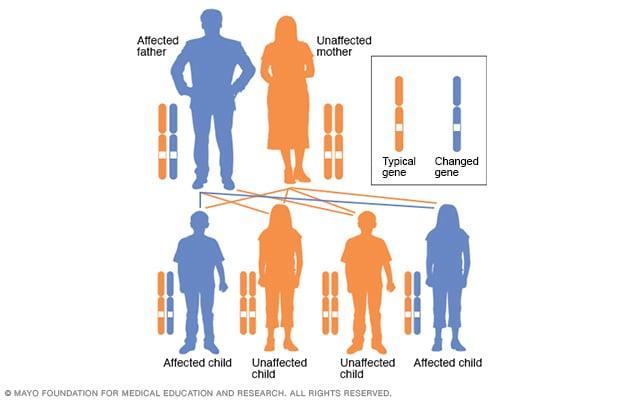
Autosomal dominant inheritance pattern
In an autosomal dominant disorder, the changed gene is a dominant gene. It's located on one of the nonsex chromosomes, called autosomes. Only one changed gene is needed to be affected by this type of condition. A person with an autosomal dominant condition — in this example, the father — has a 50% chance of having an affected child with one changed gene. The person has a 50% chance of having an unaffected child.
A change in one or more genes can cause Noonan syndrome. Changes in these genes produce proteins that are always active. Because these genes play a role in how tissues form in the body, this constant activation of proteins disrupts the typical process of cell growth and division.
The gene changes that cause Noonan syndrome can be:
- Inherited. Children who have one parent with Noonan syndrome who carries the changed gene have a 50% chance of developing the condition. This is called an autosomal dominant inheritance pattern.
- Random. Noonan syndrome can develop in a child because of a new changed gene — meaning the child did not inherit that gene from a parent. This is known as a de novo genetic condition.
In some cases, the cause of Noonan syndrome is not known.
Risk factors
A parent with Noonan syndrome has a 50% chance of passing the changed gene to a child. The child who inherits the irregular gene may or may not have more symptoms than the parent who is affected.
Complications
Complications from Noonan syndrome can arise that may need attention, including:
- Developmental delays. Children with Noonan syndrome may be slow to develop compared with other children their age. For example, they may be way behind in learning to speak or walk or in learning things at school. A plan is needed to address the children's developmental challenges and learning and educational needs.
- Bleeding and bruising. Sometimes the bleeding problem common in people with Noonan syndrome is not found until they have dental work or surgery.
- Buildup of fluid. Called lymphedema, this complication involves too much fluid that builds up in various areas of the body. Sometimes fluid can collect in the space around the heart and lungs.
- Urinary tract issues. A kidney structure that is not typical may raise the risk of urinary tract infections.
- Fertility issues. Males may have a low sperm count and other fertility problems because of undescended testicles or testicles that do not work properly.
- Higher risk of cancer. There may be a higher risk of developing certain types of cancer, such as leukemia or certain types of tumors.
Prevention
If you have a family history of Noonan syndrome, talk to your doctor or health care team about the benefits of genetic counseling before you have children. Genetic testing can detect Noonan syndrome.
If Noonan syndrome is detected early, it's possible that proper and ongoing care may lessen complications such as heart disease.