Overview
Peyronie (pay-roe-NEE) disease is a condition in which fibrous scar tissue forms in the deeper tissues under the skin of the penis. This causes curved, painful erections. It also can make the penis shorter while erect. Peyronie disease is not caused by cancer.
Penises vary in shape and size. So having a curved erection isn't always a cause for concern. But Peyronie disease causes a serious bend or pain in some people.
This can prevent you from having sex. Or it might make it hard to get or keep an erection, which also is called erectile dysfunction. For many people, Peyronie disease also causes stress and anxiety.
Peyronie disease rarely goes away on its own. In most people with the condition, it will remain as is or may get slightly worse early on. Early treatment soon after you get the condition may keep it from getting worse or even improve symptoms. Even if you've had Peyronie disease for some time, treatment may help ease symptoms such as pain, curving and shortening.
Products & Services
Symptoms
Peyronie disease symptoms might start suddenly or appear over time. The most common symptoms include:
- Scar tissue. The scar tissue linked with Peyronie disease also is called plaque. It's different from plaque that can build up in blood vessels or on your teeth. It can be felt under the skin of the penis as flat lumps or a band of hard tissue. The area over the scar tissue may feel tender.
- A bend to the penis. The penis might curve upward or downward or bend to one side.
- Erection problems. Peyronie disease might cause problems getting or keeping an erection. This also is called erectile dysfunction. Often though, people with Peyronie disease say they notice erectile dysfunction before the start of their other penile symptoms.
- Shortening of the penis. The penis might become shorter during erections due to Peyronie disease.
- Pain in the penis. This symptom might happen with or without an erection.
- Other changes in how the penis looks. In some people with Peyronie disease, the erect penis might look narrow or indented. It might even take on an hourglass-like shape, with a tight, narrow band around the shaft.
The curving and penile shortening linked with Peyronie disease might become worse over time. Physical changes in the penis often get worse or stay the same during the first year to year and a half.
Pain during erections usually gets better within 1 to 2 years. The scar tissue, penile shortening and curving often remain. It's not common, but the curving and pain of Peyronie disease can get better without treatment.
When to see a doctor
See a health care professional if you notice symptoms of Peyronie disease. Early treatment gives you the best chance to improve the condition or keep it from getting worse. If you've had the condition for some time, get a health care checkup if the pain, curving, length, or other changes bother you or your partner.
Our caring team of Mayo Clinic experts can help you with your health concerns. Visit Mayo Clinic Men's Health to
get started.
Get the process started
Causes
Flaccid and erect penis
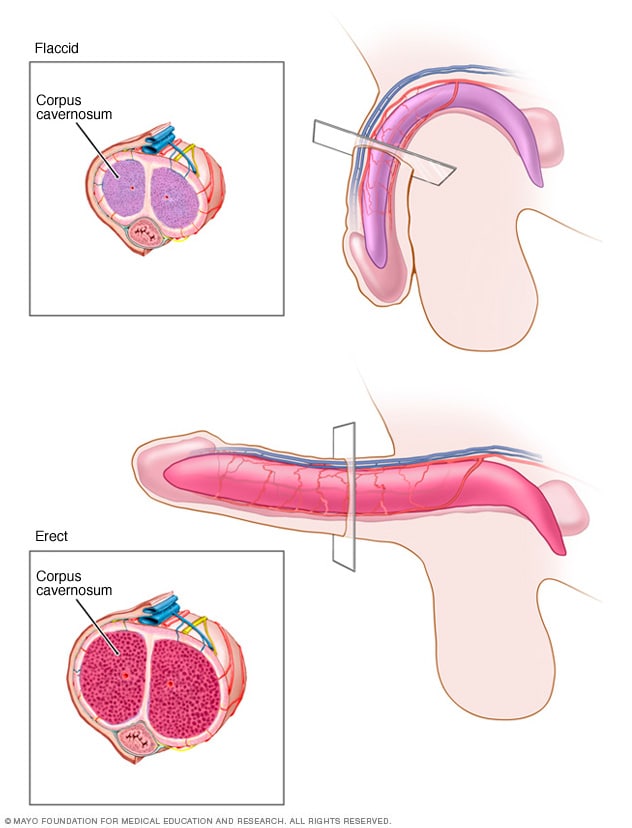
Flaccid and erect penis
The penis contains two cylinder-shaped, spongelike structures called the corpora cavernosa. During sexual arousal, nerve impulses increase blood flow to both cylinders. This sudden influx of blood causes an erection by expanding, straightening and stiffening the penis.
The exact cause of Peyronie disease isn't clear. But various factors seem to be involved.
It's thought Peyronie disease most often results from repeated injury to the penis during vigorous sex. But the penis also could be damaged during athletic activities or accidents. Many people with Peyronie disease can't recall a specific injury that led to their symptoms.
During the healing process after injury to the penis, scar tissue forms. This can lead to a lump you can feel or to a curve in the penis.
Each side of the penis contains a spongelike tube called a corpus cavernosum. These tubes have many tiny blood vessels. Each of the corpora cavernosa is encased in a sheath of elastic tissue called the tunica albuginea (TOO-nih-kuh al-BYOO-JIN-e-uh). The sheath stretches during an erection.
When you become sexually aroused, more blood flows to these chambers. As the chambers fill with blood, the penis expands, straightens and stiffens into an erection.
In Peyronie disease, when the penis becomes erect, the area with the scar tissue doesn't stretch. As a result, the penis bends or goes through other changes. This can be painful.
In most people, Peyronie disease symptoms come on slowly and don't seem to be linked with an injury. Researchers are looking into whether Peyronie disease might be tied to a genetic trait or certain health conditions.
Risk factors
Minor injury to the penis doesn't always lead to Peyronie disease. Various factors can contribute to poor wound healing and scar tissue buildup that might play a role in Peyronie disease. These include:
- Family history. If a family member has Peyronie disease, you have a higher risk of the condition.
- Connective tissue diseases. People who have certain conditions that affect connective tissue in the body seem to have a higher risk of getting Peyronie disease. For example, some people with Peyronie disease also have a thick cord under the skin of the palm that can pull the fingers inward. This is called Dupuytren contracture.
- Age. Peyronie disease can happen at any age. But it becomes more common between the ages of 45 and 70. Curving of the penis in younger men less often is due to Peyronie disease. It is more commonly called congenital penile curvature. A small amount of curvature in younger men is typical and not concerning.
Other factors might be linked to Peyronie disease. These include certain health conditions, smoking and some types of prostate surgery.
Complications
Peyronie disease might lead to troubles that include:
- Not being able to have sex.
- Trouble getting or keeping an erection, also called erectile dysfunction.
- Anxiety, stress, or depression over challenges having sex or the way your penis looks.
- Stress on your relationship with your sexual partner.
- Trouble having a child because it's challenging or not possible to have sex.
- Shorter penis length.
- Penile pain.
Our caring team of Mayo Clinic experts can help you with your health concerns. Visit Mayo Clinic Men's Health to
get started.
Get the process started