Overview
Raynaud's (ray-NOSE) disease causes some areas of the body — such as fingers and toes — to feel numb and cold in response to cold temperatures or stress. In Raynaud's disease, smaller arteries that supply blood to the skin narrow. This limits blood flow to affected areas, which is called vasospasm.
Other names for this condition are:
- Raynaud's phenomenon.
- Raynaud syndrome.
Women are more likely than men to have Raynaud's disease. It seems to be more common in people who live in colder climates.
Treatment of Raynaud's disease depends on its severity and whether you have other health conditions. For most people, Raynaud's disease isn't disabling, but it can affect your quality of life.
Symptoms
Raynaud's disease
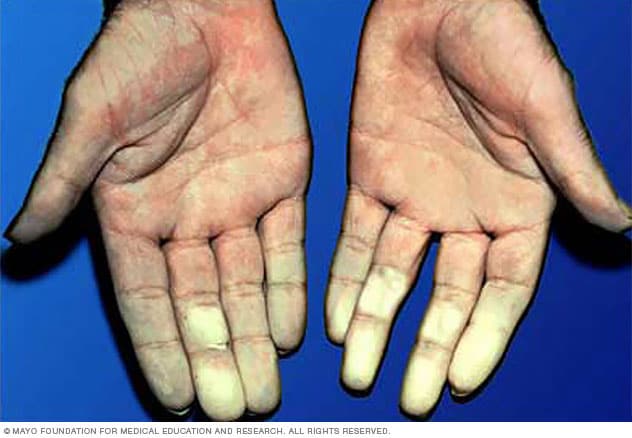
Raynaud's disease
Raynaud's disease causes smaller arteries that supply blood flow to the skin to narrow in response to cold or stress. The affected body parts, usually fingers and toes, might turn white then blue. Depending on your skin color, these color changes may be harder or easier to see. The affected areas may feel cold and numb until blood flow improves, usually after warming up.
Symptoms of Raynaud's disease include:
- Cold fingers or toes.
- Areas of skin that turn white then blue. Depending on your skin color, these color changes may be harder or easier to see.
- Numb, prickly feeling or stinging pain upon warming or stress relief.
During an attack of Raynaud's, affected areas of the skin usually first turn pale. Next, they often change color and feel cold and numb. When the skin warms and blood flow improves, the affected areas may change color again, throb, tingle or swell.
Raynaud's most commonly affects fingers and toes. But it also can affect other areas of the body, such as nose, lips, ears and even nipples. After warming up, the return of blood flow to the area can take 15 minutes.
When to see a doctor
See your health care provider right away if you have a history of severe Raynaud's and get a sore or infection in one of your affected fingers or toes.
Causes
Experts don't fully understand the cause of Raynaud's attacks. But blood vessels in the hands and feet appear to react too strongly to cold temperatures or stress.
With Raynaud's, arteries to the fingers and toes narrow when exposed to cold or stress. The narrowed arteries limit blood flow. Over time, these small arteries can thicken slightly and limit blood flow even more.
Cold temperatures are the most likely cause of an attack. Examples are putting hands in cold water, taking something from a freezer or being in cold air. For some people, emotional stress can trigger an episode.
Primary vs. secondary Raynaud's
There are two main types of the condition.
- Primary Raynaud's. Also called Raynaud's disease, this most common form isn't the result of another medical condition. It can be so mild that many people with primary Raynaud's don't seek treatment. And it can go away on its own.
-
Secondary Raynaud's. Also called Raynaud's phenomenon, this form develops because of another health condition. Although secondary Raynaud's is less common than the primary form, it tends to be more serious.
Symptoms of secondary Raynaud's usually appear around age 40. That's later than symptoms appear for primary Raynaud's.
Causes of secondary Raynaud's include:
- Connective tissue diseases. Most people who have a rare disease that leads to hardening and scarring of the skin, known as scleroderma, have Raynaud's. Other diseases that increase the risk of Raynaud's include lupus, rheumatoid arthritis and Sjogren's syndrome.
- Diseases of the arteries. These include a buildup of fatty deposits in blood vessels that feed the heart and a disorder in which the blood vessels of the hands and feet become inflamed. A type of high blood pressure that affects the arteries of the lungs also may cause secondary Raynaud's.
- Carpal tunnel syndrome. This condition involves pressure on a major nerve to the hand. The pressure causes numbness and pain in the hand that can make the hand react more to cold temperatures.
- Repeated actions or vibration. Typing, playing piano or doing movements like that for long periods can cause overuse injuries. So can using vibrating tools, such as jackhammers.
- Smoking. Smoking narrows blood vessels.
- Injuries to the hands or feet. Examples include a wrist fracture, surgery or frostbite.
- Certain medicines. These include beta blockers for high blood pressure, some migraine medicines, attention-deficit/hyperactivity disorder medicines, certain cancer medicines and some cold medicines.
Risk factors
Risk factors for primary Raynaud's include:
- Sex. The condition affects more women than men.
- Age. Although anyone can develop the condition, primary Raynaud's often begins between the ages of 15 and 30.
- Climate. The illness also is more common in people who live in colder climates.
- Family history. Having a parent, sibling or child with the disease appears to increase the risk of primary Raynaud's.
Risk factors for secondary Raynaud's include:
- Certain diseases. These include conditions such as scleroderma and lupus.
- Certain jobs. These include jobs that cause repeated trauma, such as using tools that vibrate.
- Certain substances. This includes smoking, taking medicines that affect the blood vessels and being around certain chemicals, such as vinyl chloride.
Complications
If secondary Raynaud's is severe, reduced blood flow to fingers or toes could cause tissue damage. But that's rare.
A completely blocked artery can lead to skin sores or dead tissue. This can be difficult to treat. Rarely, very bad untreated instances might require removing the affected part of the body.
Prevention
To help prevent Raynaud's attacks:
-
Bundle up outdoors. When it's cold, wear a hat, scarf, socks and boots, and two sets of mittens or gloves. Thermal underwear might help. A coat with cuffs that close around mittens or gloves helps protect the hands from cold air.
Wear earmuffs and a face mask if the tip of your nose and your earlobes get too cold.
- Warm your car. Run your car heater for a few minutes before driving in cold weather.
-
Take care indoors. Wear socks. To take food out of the refrigerator or freezer, wear gloves, mittens or oven mitts. Some people find it helpful to wear mittens and socks to bed during winter.
Because air conditioning can cause attacks, set your air conditioner to a warmer temperature. Use drinking glasses that keep hands from feeling cold.
Nov. 23, 2022