Overview
Temporal lobe seizures begin in the temporal lobes of the brain. These areas process emotions and are important for short-term memory. Symptoms of a temporal lobe seizure may be related to these functions. Some people have odd feelings during the seizure, such as joy, deja vu or fear.
Temporal lobe seizures are sometimes called focal seizures with impaired awareness. Some people remain aware of what's happening during the seizure. But if the seizure is more intense, the person might look awake but won't respond to what's around them. The person's lips and hands may make motions over and over.
The cause of temporal lobe seizures is often not known. But it may stem from a scar in the temporal lobe. Temporal lobe seizures are treated with medicine. For some people who don't respond to medicine, surgery may be an option.
Products & Services
Symptoms
An unusual sensation known as an aura may happen before a temporal lobe seizure. An aura acts as a warning. Not everyone who has temporal lobe seizures has auras. And not everyone who has auras remembers them.
The aura is the first part of a focal seizure before a loss of consciousness. Examples of auras include:
- A sudden sense of fear or joy.
- A feeling that what's happening has happened before, known as deja vu.
- A sudden or strange odor or taste.
- A rising sensation in the belly similar to being on a roller coaster.
Sometimes temporal lobe seizures impair your ability to respond to others. This type of temporal lobe seizure usually lasts 30 seconds to 2 minutes.
Symptoms of a temporal lobe seizure include:
- Not being aware of the people and things around you.
- Staring.
- Lip smacking.
- Repeated swallowing or chewing.
- Finger movements, such as picking motions.
After a temporal lobe seizure, you may have:
- A period of confusion and trouble speaking.
- Inability to recall what occurred during the seizure.
- Not being aware of having had a seizure.
- Extreme sleepiness.
In extreme cases, what starts as a temporal lobe seizure evolves into a generalized tonic-clonic seizure. This type of seizure causes shaking, known as convulsions, and loss of consciousness. It also is called a grand mal seizure.
When to see a doctor
Call 911 or your local emergency number if any of the following occurs:
- The seizure lasts more than five minutes.
- Breathing or consciousness doesn't return after the seizure stops.
- A second seizure follows immediately.
- Recovery isn't complete after the seizure is over.
- Recovery is slower than usual after the seizure is over.
- You have a high fever.
- You're experiencing heat exhaustion.
- You're pregnant.
- You have diabetes.
- You've injured yourself during the seizure.
If you experience a seizure for the first time, see a health care provider.
Seek medical advice if:
- You think you or your child has had a seizure.
- The number of seizures increases without explanation. Or the seizures become more intense.
- New seizure symptoms appear.
Causes
Brain lobes
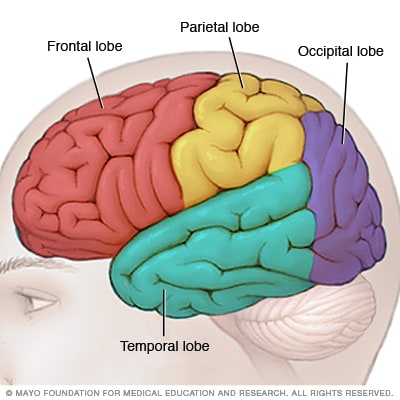
Brain lobes
Each side of your brain contains four lobes. The frontal lobe is important for cognitive functions and control of voluntary movement or activity. The parietal lobe processes information about temperature, taste, touch and movement, while the occipital lobe is primarily responsible for vision. The temporal lobe processes memories, integrating them with sensations of taste, sound, sight and touch.
Often, the cause of temporal lobe seizures is not known. But they can be a result of a number of factors, including:
- Traumatic brain injury.
- Infections such as encephalitis or meningitis. Or a history of such infections.
- A process that causes scarring in a part of the temporal lobe called the hippocampus. This is known as gliosis.
- Blood vessel malformations in the brain.
- Stroke.
- Brain tumors.
- Genetic syndromes.
During waking and sleeping, your brain cells produce varying electrical activity. If there's a burst of electrical activity in many brain cells, a seizure may occur.
If this happens in just one area of the brain, the result is a focal seizure. A temporal lobe seizure is a focal seizure that originates in one of the temporal lobes.
Complications
Over time, repeated temporal lobe seizures can cause the part of the brain that's responsible for learning and memory to shrink. This area of the brain is called the hippocampus. The loss of brain cells in the hippocampus may cause memory problems.