Overview
Vocal cord paralysis is a condition in which you can't control the movement of the muscles that control your voice. It happens when the nerve impulses to your voice box (larynx) are disrupted. This results in paralysis of the vocal cord muscles.
Vocal cord paralysis can make it hard to speak and even breathe. That's because your vocal cords, also called vocal folds, do more than just produce sound. They also protect your airway by preventing food, drink and even your saliva from entering your windpipe (trachea) and causing you to choke.
Possible causes of vocal cord paralysis include nerve damage during surgery, viral infections and certain cancers. Treatment for vocal cord paralysis usually involves surgery, and sometimes voice therapy.
Products & Services
Symptoms
Vocal cords open and closed
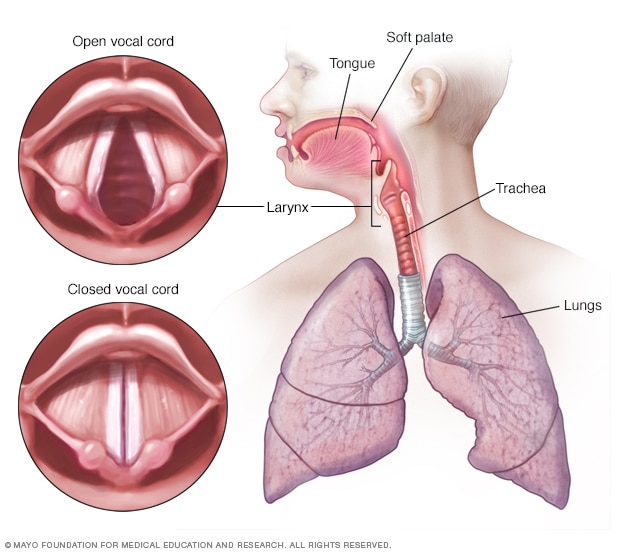
Vocal cords open and closed
Vocal cords open when you breathe and then close to produce sound when vibrating together.
Your vocal cords are two flexible bands of muscle tissue that sit at the entrance to the windpipe (trachea). When you speak, the bands come together and vibrate to make sound. The rest of the time, the vocal cords are relaxed in an open position so that you can breathe.
In most cases of vocal cord paralysis, only one vocal cord is paralyzed. Paralysis of both of your vocal cords is a rare but serious condition. This can cause difficulties with speech and significant problems with breathing and swallowing.
Signs and symptoms of vocal cord paralysis may include:
- A breathy quality to the voice
- Hoarseness
- Noisy breathing
- Shortness of breath
- Loss of vocal pitch
- Choking or coughing while swallowing food, drink or saliva
- The need to take frequent breaths while speaking
- Inability to speak loudly
- Loss of your gag reflex
- Ineffective coughing
- Frequent throat clearing
When to see a doctor
If you have unexplained hoarseness that lasts for more than 2 to 4 weeks, or if you notice any unexplained voice changes or discomfort, contact your health care provider.
Causes
In vocal cord paralysis, the nerve impulses to your voice box (larynx) are disrupted, causing paralysis of the muscle. Health care providers often can't determine the exact cause of vocal cord paralysis. But some known causes may include:
- Injury to the vocal cord during surgery. Surgery on or near the neck or upper chest can result in damage to the nerves that serve the voice box. Surgeries that carry a risk of damage include surgeries to the thyroid or parathyroid glands, esophagus, neck, and chest.
- Neck or chest injury. Trauma to the neck or chest may injure the nerves that serve the vocal cords or the voice box itself.
- Stroke. A stroke interrupts blood flow in the brain and may damage the part of the brain that sends messages to the voice box.
- Tumors. Tumors, both cancerous and noncancerous, can grow in or around the muscles, cartilage or nerves controlling the function of the voice box and can cause vocal cord paralysis.
- Infections. Some infections, such as Lyme disease, Epstein-Barr virus and herpes, can cause inflammation and directly damage the nerves in the voice box. There's some evidence that infection with COVID-19 may cause vocal cord paralysis.
- Neurological conditions. Certain neurological conditions, such as multiple sclerosis or Parkinson's disease, can lead to vocal cord paralysis.
Risk factors
Factors that may increase your risk of developing vocal cord paralysis include:
- Undergoing throat or chest surgery. People who need surgery on their thyroid, throat or upper chest have an increased risk of vocal cord nerve damage. Sometimes the breathing tubes used in surgery or to help you breathe if you're having serious respiratory trouble can damage the vocal cord nerves.
- Having a neurological condition. People with certain neurological conditions — such as Parkinson's disease or multiple sclerosis — are more likely to develop vocal cord weakness or paralysis.
Complications
Breathing problems associated with vocal cord paralysis may be so mild that you just have a hoarse-sounding voice, or they can be so serious that they're life-threatening.
Because vocal cord paralysis keeps the opening to the airway from completely opening or closing, other complications may include choking on or inhaling (aspirating) food or liquid. Aspiration that leads to severe pneumonia is rare but serious and requires immediate medical care.