Hydrocephalus


MayoClinic.com reprints

This single copy is for your personal, noncommercial use only. For permission to reprint multiple copies or to order presentation-ready copies for distribution, use the reprints link below.

· Order reprints of this article now.

Hydrocephalus

By Mayo Clinic staff

Mayo Clinic Health Manager

Get free personalized health guidance for you and your family.

Get Started

Free

E-Newsletter

Subscribe to receive the latest updates on health topics. About our newsletters

  • Housecall
  • Alzheimer's caregiving
  • Living with cancer

Definition

Hydrocephalus occurs when excess fluid builds up in your brain, most often because of an obstruction preventing proper fluid drainage. The excess fluid can compress surrounding, fragile brain tissue, causing brain damage. Left untreated, hydrocephalus can be fatal.

Once known as "water on the brain," hydrocephalus is sometimes present at birth, although it may develop later. About 1 out of 500 children is born with the disorder. The outlook if you have hydrocephalus depends on how quickly the condition is diagnosed and whether any underlying disorders are present.

Symptoms

The signs and symptoms of hydrocephalus vary by age group and disease progression.

In infants, common signs and symptoms of hydrocephalus include:

  • An unusually large head
  • A rapid increase in the size of the head
  • A bulging "soft spot" on the top of the head
  • Vomiting
  • Sleepiness
  • Irritability
  • Seizures
  • Eyes fixed downward (sunsetting of the eyes)
  • Developmental delay

In older children and adults, common signs and symptoms of hydrocephalus include:

  • Headache followed by vomiting
  • Nausea
  • Blurred or double vision
  • Eyes fixed downward (sunsetting of the eyes)
  • Problems with balance, coordination or gait
  • Sluggishness or lack of energy
  • Slowing or regression of development
  • Memory loss
  • Confusion
  • Urinary incontinence
  • Irritability
  • Changes in personality
  • Impaired performance in school or work

Hydrocephalus produces different combinations of these signs and symptoms, depending on its cause, which also varies by age. For example, a condition known as normal pressure hydrocephalus, which mainly affects older people, typically starts with difficulty walking. Urinary incontinence often develops, along with a type of dementia marked by slowness of thinking and information processing.

When to see a doctor
Infants and toddlers require emergency medical care for these signs and symptoms:

  • A high-pitched cry
  • Problems with sucking or feeding
  • Unexplained, recurrent vomiting
  • Exhibiting an unwillingness to bend or move the neck or head
  • Breathing difficulties
  • Seizures

The following signs and symptoms don't constitute an emergency, but they do warrant a call to your child's doctor:

  • A rapid increase in the size of the head
  • A bulging "soft spot" on the top of the head
  • A change in the appearance of the face or eyes
  • A decreased level of interest or engagement in social interactions

Older adults need a complete physical and neurological exam if experiencing:

  • Walking difficulties
  • Impaired thinking
  • Urinary incontinence

Causes

CLICK TO ENLARGE

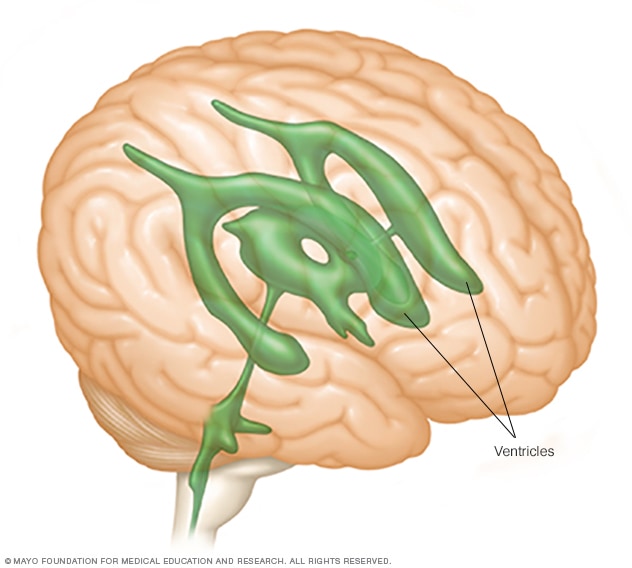
Illustration showing brain ventricles
Brain ventricles

Hydrocephalus is caused by excess fluid buildup in your brain.

Your brain is the consistency of gelatin, and it floats in a bath of cerebrospinal fluid. This fluid also fills large open structures, called ventricles, which lie deep inside your brain. The fluid-filled ventricles help keep the brain buoyant and cushioned.

Cerebrospinal fluid flows through the ventricles by way of interconnecting channels. The fluid eventually flows into spaces around the brain, where it's absorbed into your bloodstream.

Keeping the production, flow and absorption of cerebrospinal fluid in balance is important to maintaining normal pressure inside your skull. Hydrocephalus results when the flow of cerebrospinal fluid is disrupted — for example, when a channel between ventricles becomes narrowed — or when your body doesn't properly absorb this fluid.

Defective absorption of cerebrospinal fluid causes normal pressure hydrocephalus, seen most often in older people. In normal pressure hydrocephalus, excess fluid enlarges the ventricles but does not increase pressure on the brain. Normal pressure hydrocephalus may be the result of injury or illness, but in many cases the cause is unknown.

Risk factors

Premature infants have an increased risk of severe bleeding within the ventricles of the brain (intraventricular hemorrhage), which can lead to hydrocephalus.

Certain problems during pregnancy may increase an infant's risk of developing hydrocephalus, including:

  • An infection within the uterus
  • Problems in fetal development, such as incomplete closure of the spinal column

Congenital or developmental defects not apparent at birth also can increase older children's risk of hydrocephalus.

Other factors that increase your risk of hydrocephalus include:

  • Lesions or tumors of the brain or spinal cord
  • Central nervous system infections
  • Bleeding in the brain
  • Severe head injury

Complications

The severity of hydrocephalus depends on the age at which the condition develops and the course it follows. If the condition is well advanced at birth, major brain damage and physical disabilities are likely. In less severe cases, with proper treatment, it's possible to have a nearly normal life span and intelligence.

Preparing for your appointment

Hydrocephalus is often detected at birth or in early infancy when a baby shows the characteristic sign of an enlarged head. It's likely that your family doctor or your child's pediatrician will notice these signs and symptoms during regular checkups.

In older children or adults, call your doctor if you notice changes that are similar to the signs and symptoms of hydrocephalus. After an initial evaluation, your doctor may refer you to a doctor who specializes in the diagnosis and treatment of conditions that affect the brain and nervous system (neurologist).

Here's some information to help you get well prepared for your appointment.

What you can do

  • Write down any signs and symptoms you or your child has been experiencing, and for how long.
  • Note any recent injuries that may have caused head trauma.
  • Write down key medical information, including other medical problems for which you or your child are being treated. Also list the names of any medications, vitamins, supplements or other natural remedies you or your child is taking.
  • Ask a trusted family member or friend to join you for the appointment. If hydrocephalus is diagnosed, you may have great difficulty focusing on anything the doctor says next. Take someone along who can offer emotional support and can help you soak up all the information.
  • Write down the questions you want to be sure to ask your doctor.

For hydrocephalus, some basic questions to ask your doctor include:

  • What is likely causing these signs and symptoms?
  • Are there any other possible causes?
  • How will you determine a firm diagnosis?
  • What treatment do you recommend?
  • With treatment, is a normal life possible?
  • What are the possible complications of treatment?
  • What signs or symptoms — related to this condition or its treatments — should prompt me to call you?
  • What signs or symptoms should prompt me to call 911 or my local emergency number?
  • How frequently will follow-up care be needed?
  • Could specialists in other areas help detect and treat problems commonly associated with this condition? Will you provide a referral?
  • Are any future children of mine at increased risk of this condition?
  • How can I find other families who are coping with hydrocephalus?

What to expect from your doctor
Your doctor is likely to ask you a number of questions. Being ready to answer them may reserve time to go over any points you want to talk about in-depth. Your doctor may ask:

  • What signs or symptoms have you noticed?
  • Have these signs or symptoms changed over time?
  • Do these signs or symptoms include nausea or vomiting?
  • Do these signs or symptoms include eye or vision problems?
  • Have you noticed any personality changes, including increased irritability?
  • Have you noticed any new problems with movement or coordination?
  • Have signs or symptoms included abnormal sleepiness or lack of energy?
  • In infants: Have signs and symptoms included seizures?
  • In infants: Have signs and symptoms included problems with eating or breathing?
  • In older children and adults: Have signs and symptoms included headache?
  • In older children and adults: Have signs and symptoms included urinary incontinence?
  • Have you or your child had a recent head injury?
  • Are you or is your child being treated for any other medical conditions?

What you can do in the meantime
If you notice any emergency signs or symptoms of hydrocephalus in your child — such as difficulty eating or breathing, recurrent vomiting, seizures, or an unwillingness to move the head or neck — call 911 or your local emergency number immediately.

Tests and diagnosis

In babies and young children, hydrocephalus is likely to be diagnosed:

  • During gestation as part of a routine prenatal ultrasound
  • During infancy or early childhood, when the head is regularly measured as part of growth monitoring

If your baby's head is visibly enlarged or its growth over time is more rapid than that of other infants, your doctor may recommend an ultrasound of the head. If the results of the ultrasound are abnormal, your infant will need further evaluation.

In older children and adults, a doctor may diagnose hydrocephalus after the child or adult develops signs or symptoms of the condition. To help make the diagnosis, your doctor is likely to perform:

  • A careful medical history
  • A physical and neurological examination
  • Computerized tomography (CT) or magnetic resonance imaging (MRI)

If detailed pictures of the brain from imaging tests reveal hydrocephalus or other abnormalities, referral to a brain surgeon for further evaluation and treatment is likely.

Treatments and drugs

CLICK TO ENLARGE

Illustration of a shunt system 
Shunt system

Hydrocephalus is usually treated with surgery. Options include:

  • Shunt placement. The most common treatment for hydrocephalus is the surgical insertion of a drainage system, called a shunt. It consists of a long flexible tube with a valve that keeps fluid from the brain flowing in the right direction and at the proper rate. One end of the tubing is usually placed in one of the brain's ventricles. The tubing is then tunneled under the skin to another part of the body where the excess cerebrospinal fluid can be more easily absorbed — such as the abdomen or a chamber in the heart.

    People who have hydrocephalus usually need a shunt system for the rest of their lives, so additional surgeries may be needed to insert longer tubing to match a child's growth. Revisions to the shunt also may be needed if the tubing becomes blocked or infected.

  • Ventriculostomy. This surgical procedure is sometimes used when there's an obstruction of flow between ventricles. In the procedure, your surgeon makes a hole in the bottom of one of the ventricles, to allow the cerebrospinal fluid to flow toward the base of the brain, where normal absorption occurs.

Caring for the whole child
If your child has hydrocephalus, his or her doctor may recommend working with specialists who can help your child thrive in daily life and at school, such as:

  • Occupational therapists
  • Pediatric psychologists
  • Educational experts

These specialists will likely evaluate your child's developmental progress on a regular basis in order to detect any delays in social, intellectual, emotional or physical development. Effective interventions are available to help your child reach his or her full potential.

Coping and support

With the help of rehabilitation therapies and educational interventions, many people with hydrocephalus live with few limitations.

There are many resources available to provide emotional and medical support as you parent a child with hydrocephalus. Children with developmental problems due to hydrocephalus may be eligible for government-sponsored health care and other support services. Check with your state or county social services agency.

Hospitals and voluntary organizations serving people with disabilities are good resources for emotional and practical support, as are doctors and nurses. Ask these resources to help you connect with other families who are coping with hydrocephalus.

Adults living with hydrocephalus may find valuable information and support from organizations dedicated to hydrocephalus education and support, such as the Hydrocephalus Association.

Prevention

To reduce the risk of hydrocephalus:

  • If you're pregnant, get regular prenatal care. Following your doctor's recommended schedule for checkups during pregnancy can reduce your risk of premature labor, which places your baby at risk of hydrocephalus and other complications.
  • Protect against infectious illness. Follow the recommended vaccination and screening schedules for your age and sex. Preventing and promptly treating the infections and other illnesses associated with hydrocephalus may reduce your risk.

To prevent head injury:

  • Use appropriate safety equipment. For babies and children, use a properly installed, age- and size-appropriate child safety seat on all car trips. Make sure all your baby equipment — crib, stroller, swing, highchair — meets all safety standards and is properly adjusted for your baby's size and development. Older children and adults should wear a helmet while riding a bicycle, skateboard, motorcycle, snowmobile or all-terrain vehicle.
  • Always wear a seat belt in a motor vehicle. Small children should be secured in child safety seats or booster seats. Depending on their size, older children may be adequately restrained with seat belts.

Should you be vaccinated against meningitis?
Ask your doctor if you or your child should receive a vaccine against meningitis, once a common cause of hydrocephalus. A meningitis vaccine is now recommended for people ages 2 and older who are at increased risk of this disease due to:

  • Traveling to countries where meningitis is common
  • Having an immune system disorder called terminal complement deficiency
  • Having a damaged spleen or having had your spleen removed
  • Living in a dormitory as a college freshman
  • Joining the military
References
  1. Hydrocephalus fact sheet. National Institute of Neurological Disorders and Stroke. http://www.ninds.nih.gov/disorders/hydrocephalus/detail_hydrocephalus.htm?css=print. Accessed July 17, 2009.
  2. Fishman MA. Hydrocephalus. http://www.uptodate.com/home/index.html. Accessed July 17, 2009.
  3. Golden JA, et al. Developmental structural disorders. In: Goetz GD. Textbook of Clinical Neurology. 3rd ed. Philadelphia, Pa.: W.B. Saunders; 2007. http://www.mdconsult.com/das/book/body/150609977-3/864809399/1488/253.html#4-u1.0-B978-1-4160-3618-0..10028-1_1756. Accessed July 17, 2009.
  4. About hydrocephalus: A book for families. Hydrocephalus Association. http://www.hydroassoc.org/docs/AboutHydrocephalus-A_Book_for_Families_Dec08.pdf. Accessed July 17, 2009.
  5. Meningococcal: Who needs to be vaccinated? http://www.cdc.gov/vaccines/vpd-vac/mening/who-vaccinate.htm. Centers for Disease Control & Prevention. Accessed July 17, 2009.

DS00393

Sept. 12, 2009

© 1998-2009 Mayo Foundation for Medical Education and Research (MFMER). All rights reserved. A single copy of these materials may be reprinted for noncommercial personal use only. "Mayo," "Mayo Clinic," "MayoClinic.com," "EmbodyHealth," "Reliable tools for healthier lives," "Enhance your life," and the triple-shield Mayo Clinic logo are trademarks of Mayo Foundation for Medical Education and Research.

Print Share Reprints

Text Size: smaller largerlarger