Overview
Penis before and after circumcision
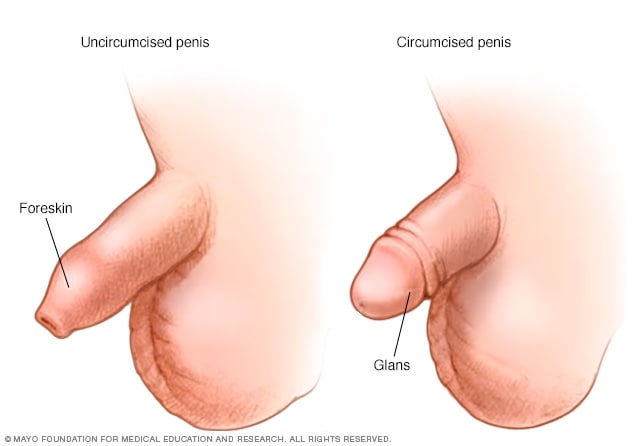
Penis before and after circumcision
Before circumcision, the foreskin covers the tip of the penis (glans). After circumcision, the tip of the penis is exposed.
Circumcision is a surgery to remove the skin that covers the tip of the penis, also called the foreskin. The procedure is fairly common for newborn boys in parts of the world, including the United States. Circumcision later in life can be done, but it has more risks and recovery may take longer.
For some families, circumcision is a religious ritual. The procedure also can be a matter of cultural or ethnic traditions, personal hygiene, or preventive healthcare. But for others, circumcision doesn't seem to be needed, or it seems risky.
Products & Services
Why it's done
Circumcision is a religious or cultural tradition for many Jewish and Islamic families, as well as certain Indigenous peoples. Circumcision also can be a part of family tradition, personal cleanliness or preventive healthcare.
Sometimes there's a medical need for circumcision. For example, the foreskin might be too tight to be pulled back over the tip of the penis. Circumcision also is recommended as a way to lower the risk of HIV in countries where the virus is prevalent. This includes parts of Africa.
Circumcision might have various health benefits, including:
- Easier hygiene. Circumcision makes it simpler to wash the penis. Still, boys who haven't been circumcised can be taught to wash regularly beneath the foreskin.
- Lower risk of urinary tract infections (UTIs). The risk of UTIs in males is low. But these infections are more common in males who haven't been circumcised. Serious infections early in life can lead to kidney problems later.
- Lower risk of sexually transmitted infections. Men who have been circumcised might have a lower risk of certain sexually transmitted infections, including HIV. But it's still key to have safe sex, which includes use of condoms.
- Prevention of penile problems. Sometimes, the foreskin on a penis that hasn't been circumcised can be hard or impossible to pull back. This is called phimosis. It can lead to swelling, called inflammation, of the foreskin or head of the penis.
- Lower risk of penile cancer. Although cancer of the penis is rare, it's less common in men who have been circumcised. What's more, cervical cancer is less common in the female sexual partners of men who have been circumcised.
Still, the risks of not being circumcised are rare. The risks also can be lowered with proper care of the penis.
Your healthcare professional may recommend that you delay circumcision for your baby or not have it done if your baby:
- Has a condition that affects how blood clots.
- Was born early and still needs medical care in the hospital nursery.
- Was born with conditions that affect the penis.
Circumcision doesn't affect a child's ability to have a baby in the future. And in general, it's not thought to lessen or improve sexual pleasure for men or their partners.
Risks
The most common risks of circumcision are bleeding and infection. With bleeding, it's typical to see a few drops of blood from the surgical wound. Bleeding often stops on its own or with a few minutes of gentle direct pressure. Worse bleeding needs to be checked by a healthcare professional. Side effects related to anesthesia can happen as well.
Rarely, circumcision may cause foreskin problems. For example:
- The foreskin might be cut too short or too long.
- The foreskin might not heal properly.
- The remaining foreskin might reattach to the end of the penis, requiring minor surgical repair.
These risks are lower when the procedure is done by a doctor such as an obstetrician-gynecologist, a urologist or a pediatrician. The risks also are lower when the circumcision is done in a medical setting, such the hospital nursery or doctor's office. If the procedure occurs elsewhere for religious or cultural reasons, the person who does the circumcision should be experienced. This person should be well trained in how to do circumcisions, ease pain and prevent infection.
How you prepare
Before a circumcision, your healthcare professional talks with you about the risks and benefits of the procedure. Ask what type of pain relief medicine will be used. Whether the circumcision is for you or your child, you'll likely need to provide written consent for the procedure.
What you can expect
During the procedure
Newborn circumcision often is done in the hospital nursery, usually within the first few days after birth.
For newborn circumcision, your baby lies on the back with the arms and legs restrained. The penis and surrounding area are cleansed. A medicine to prevent pain, called an anesthetic, is given. The medicine is injected into the base of the penis or put on the penis as a cream. A special clamp or plastic ring is attached to the penis, and the foreskin is removed.
Afterward, a healthcare professional covers the penis with an ointment such as a topical antibiotic or petroleum jelly. Then the penis is wrapped loosely with gauze. The procedure often takes about 5 to 10 minutes.
Older boys and adults who get circumcisions might need medicine that prevents pain and brings on a sleep-like state. This is called general anesthesia. Afterward, recovery might take longer. And the risk of medical problems might be higher.
After the procedure
It usually takes 7 to 10 days for the penis to heal. The tip of the penis is likely to be sore at first. The penis might look discolored, swollen or bruised. You might notice a small amount of yellow fluid on the tip of the penis as well.
If your newborn is fussy as the pain medicine wears off, hold your baby gently. Be careful not to put pressure on the penis.
It's OK to wash the penis with warm water and mild soap as it heals. Then gently pat dry. For newborns, change the bandage with each diaper change. Your healthcare professional may tell you to put antibiotic ointment on the bandage. Or you can put a dab of petroleum jelly on the tip of the penis. This keeps it from sticking to the diaper. Change your baby's diaper often, and make sure the diaper is loosely fastened.
If there's a plastic ring instead of a bandage, it drops off on its own. Often, this happens in about a week or 10 days. Once the penis heals, wash it with soap and water during regular bathing.
Problems after circumcision are not common. But call a healthcare professional if:
- Urination doesn't resume within 12 hours of the circumcision.
- Your baby runs a fever.
- Your baby cries a lot, and you think your baby might be in pain.
- Bleeding doesn't stop.
- A color change at the tip of the penis gets worse after 3 to 5 days.
- There's foul-smelling drainage from the tip of the penis.
- The plastic ring remains in place two weeks after the circumcision or moves onto the shaft of the penis.